
Choosing a solo surf camp Morocco trip is one of the best decisions a nervous buyer can make, and one of the most googled. We run a small camp in Imsouane, a fishing village two hours north of Agadir airport, and about half of our guests arrive on their own. That’s the bias this page is written from, and it’s also why we have strong opinions about solo travel to a surf camp — we watch it play out most weeks of the year, and we’ve seen every variant of “will this work for me?” that a solo buyer brings with them.
The short version: going to a surf camp on your own is one of the best trips you can book. It’s not a consolation prize for not having someone to travel with. It’s actually a better structure for a surf week than travelling as a pair, because everything you worry about as a solo — “will I have people to eat with”, “will it be awkward”, “will I feel safe” — is already solved by how a good camp operates. Below is the honest version, written for UK buyers, with Morocco-specific context.
Why a solo surf camp Morocco trip is the best combo
When you book a standalone solo trip (a rental, a city break, a driving route), you inherit a day-planning problem: where to eat, where to go, who to talk to. You solve that problem yourself, every morning, for a week. Some people genuinely enjoy that. Most find it heavier than they expected.
A surf camp strips that problem out of your trip. The day has a shape before you wake up — theory, breakfast, morning session, lunch, nap, afternoon session, sunset, dinner, sleep. There’s a group you already belong to. There’s a house where food appears at fixed times. There are instructors whose job is to remember your name on day one. You don’t have to engineer a social week; you just show up, and it happens around you.
The second thing that makes solo + surf camp work is that the activity is the social glue. Surfing together is a strong bond fast. You sit in a lineup with strangers in the morning, you share the wipeout story at lunch, and by day three you’re in someone’s car picking up a coffee. You don’t need common hobbies or shared history — the week builds them for you.
Third: no one-friend-cancelled risk. If you were travelling as a pair and the other person pulled out, your trip would wobble. As a solo, you cannot have that wobble. Your trip is yours.
Is Morocco safe for solo travellers?
Let’s get this one out of the way properly instead of hedging. The UK Foreign Office publishes travel advice for Morocco at gov.uk/foreign-travel-advice/morocco, and it’s the honest source to read before you book anything — ours included.
The headline points (as of our check on 2026-04-18):
- Petty crime (pickpocketing, bag-snatching) is most common in tourist-dense areas — medinas, city beaches, busy markets. A small fishing village is a different risk profile from Marrakech’s main square.
- The advice recommends loose-fitting clothing that covers arms, legs and chest in public areas. That’s a practical tip, not a moral judgement.
- Avoid quiet areas after dark, particularly on your own. Take the same care you would on the outskirts of any unfamiliar town back home.
- Unregulated taxis are the biggest transport warning. Prefer pre-arranged transfers or booked rides over hailing random cars.
- A serious methanol warning exists for Morocco — some counterfeit alcohol has caused hospitalisations and deaths. Methanol can’t be detected by taste or smell, so if you drink, stick to venues that serve branded product from sealed bottles.
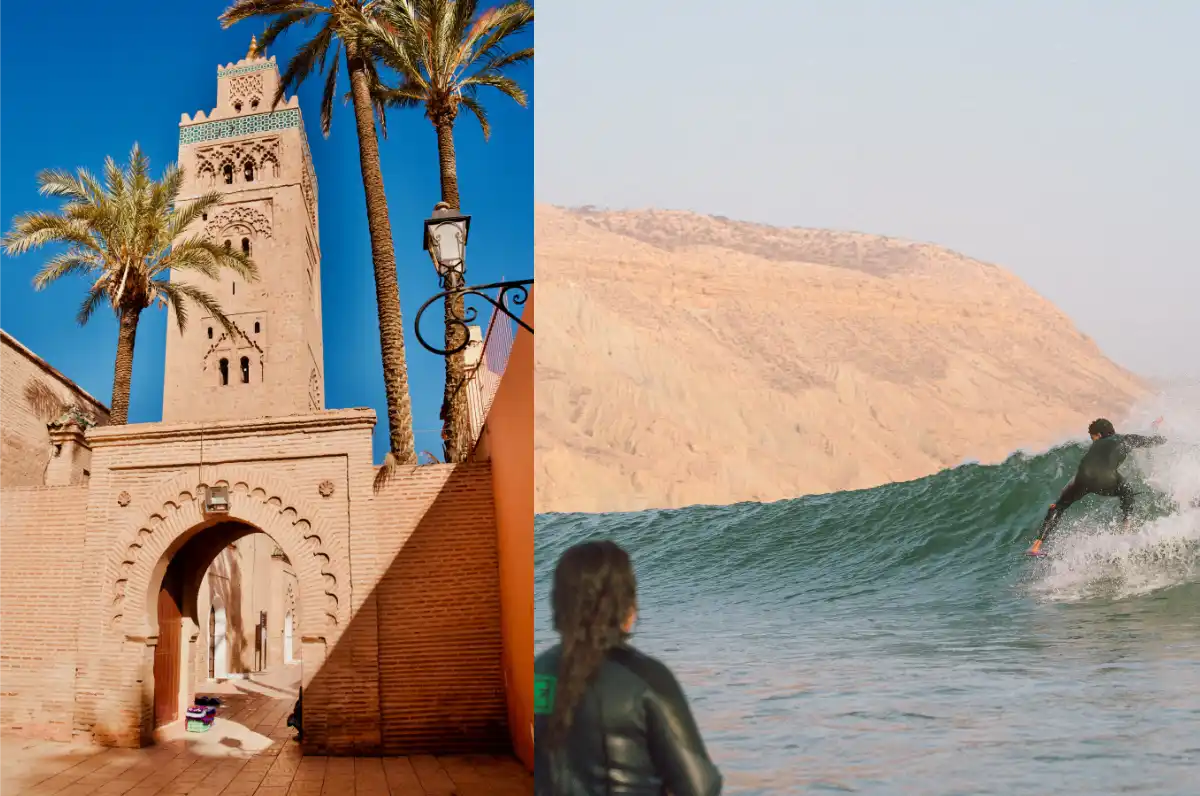
How much of this matters once you’re inside a surf camp in Imsouane? Less than you’d expect. You arrive on a pre-arranged private transfer (not a street taxi). You sleep in a camp everyone in the village knows. Your transport to the surf breaks is the camp van, with the same driver each day. You walk between the camp, the Bay and the cafés in a village that has a few hundred people in it, most of whom recognise the camp guests on sight. The risks the Foreign Office warns about are largely city-and-transit risks, and your trip isn’t built around those.
That said — none of this is a promise that nothing will ever go wrong. Apply the same situational awareness you would anywhere unfamiliar. Keep valuables light. If something feels off, it is off. The camp host is your first call for anything. Our Morocco surf trip planning guide covers visas, SIMs, and cash norms in more detail.
Solo female travel: the honest picture
A huge share of the “solo surf camp Morocco” search intent is specifically solo female travel. The top-ranking result for the query is literally titled “Female Solo Travel Tale”. It would be weird to ignore that, so we won’t.
Women travelling on their own in Morocco sometimes get unwanted attention, particularly in busy public areas and medinas. That’s what the gov.uk advice flags, and it matches what our female guests tell us from time in the bigger cities before or after a camp week. It is not a description of what happens inside Imsouane, where the village rhythm is fishing boats unloading in the morning and a handful of cafés serving the same faces every day.
What a good camp does for a solo female traveller:
- Pre-arranged transfer from the airport. You don’t negotiate with a stranger at the arrivals hall. You’re met by a driver holding your name, with the camp’s number on the booking.
- A house, not a bed in a hostel. The communal space is the camp’s, not a mixed-nationality dorm room with strangers cycling through.
- A group. By day two you are known. By day three you have people to walk to dinner with. You are never the only woman at the table.
- Staff who know you’re staying. If you don’t come back for dinner, someone notices.
- A village context. Imsouane is walkable. You can get from your bed to the Bay to the café in daylight without needing a taxi.
None of this is a guarantee, and anyone selling you a guarantee is lying. But as an honest picture, solo female travellers have very good trips at well-run camps in Imsouane, and they have them week after week.
What group size should you look for?
Here is the thing nobody says out loud: the single biggest variable in whether a solo surf camp trip “works” is group size.
Too small (a camp with you and two other guests that week) and you get an awkward dinner and an instructor-led social life. Too big (a camp with 30+ guests) and you become the solo at the far end of the long table, in a group that’s already split into cliques by day two.
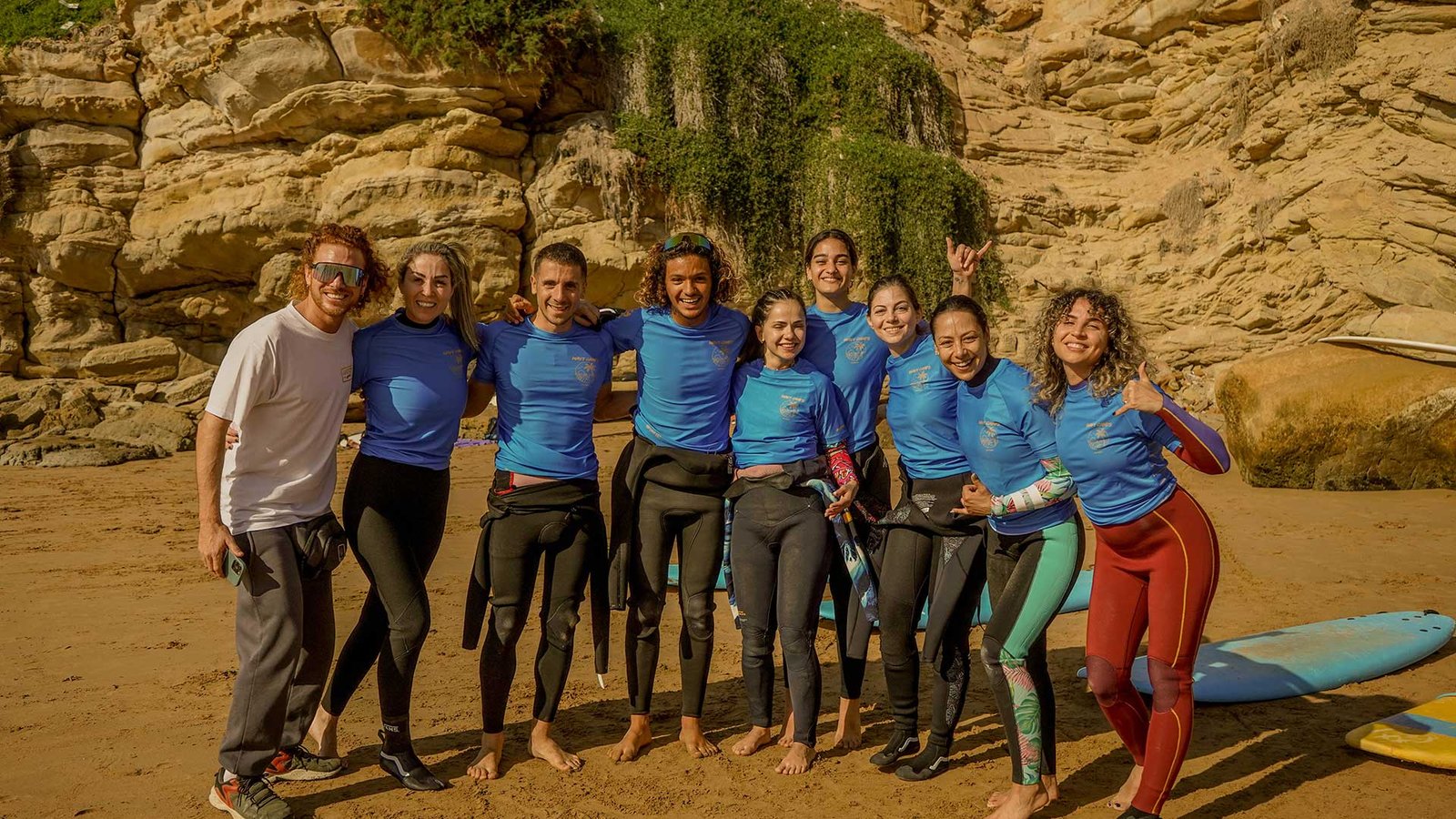
The sweet spot for solos is a camp with 4 to 10 guests at peak. That’s enough that the table is social without being overwhelming. You’ll know everyone’s name by dinner on night one. By day three you’ll have a clear idea of which two or three people you want to go for a post-surf beer with. That’s the shape of a good solo week.
Instructor ratios matter for the same reason. A small group with one or two instructors who mix students across ability levels (rather than siloing you into your own bracket for the whole week) gives a solo traveller a bigger pool of people to bond with. Our how to choose a surf camp in Morocco guide has a longer checklist on instructor questions specifically.
If you’re the kind of traveller who specifically wants a bigger, louder, party-camp vibe — that exists, and you can find it further down the coast. It’s just not what we run, and it’s rarely what solo travellers actually enjoy once they’re in it.
Dorm vs private room for solo travellers
When you book a camp on your own, the room question is a live decision. Here’s the trade-off honestly:
Dorm (or shared room). Cheaper. You share with one to three other guests, usually the same gender. You meet people before dinner on night one, because you’re literally unpacking next to them. The downside: less decompression. After a long surf day, you may want a door that closes behind you.
Private room. More expensive. You get your own door, your own bed, your own morning routine. The downside for pure social-mix: you don’t have a built-in roommate. You’re meeting people at breakfast and dinner rather than at 11pm when they come back in.
Our rough guidance: if this is your first surf trip, if you’re nervous, and if cost is a factor, dorm is excellent. You’ll be more social faster, and the “what do I do now?” moment of day-one evening vanishes. If you’re a seasoned solo traveller, a light sleeper, or someone who needs a room to retreat to, go private. The camp group dynamic still forms at meals — you don’t need a shared room to get it.
Most camps, including ours, offer both configurations. Our bed & breakfast page shows the current options if you want to see what a private-room-for-one looks like in practice.
The solo surf camp Morocco checklist
Not every surf camp in Morocco is actually set up for solos, no matter what the website says. Some are couples-heavy. Some are group-booking-heavy (think stag weeks disguised as surf trips). Some are so large that solos get absorbed into the background.
Signs a camp is genuinely solo-friendly:
- Communal dinner every night, not a buffet. A shared table forces you to meet people. A self-serve buffet lets you eat in the corner and leave.
- Shared transport to the breaks. Van life is social. If guests drive themselves in separate cars, the social glue thins.
- Mixed-ability surf sessions. If beginners are rigidly siloed from intermediates, solos get a smaller pool of people to mix with.
- A host who introduces new arrivals. This is a small thing that makes a huge difference. On day one, your first “hello” should be made for you, not by you.
- At least one shared evening ritual. Sunset terrace drinks, a rooftop moment, a post-dinner game. Something that pulls the group together once a day outside of surfing.
- A published single-supplement policy (or none at all). If a camp charges solos a heavy surcharge with no transparency, that tells you how they think about their solo market.
Read the camp’s reviews specifically for the word “solo”. If the reviews all describe couples’ trips or family trips, the camp is probably fine — but it’s telling you where its centre of gravity is.
Why Imsouane suits solo travellers better than Taghazout
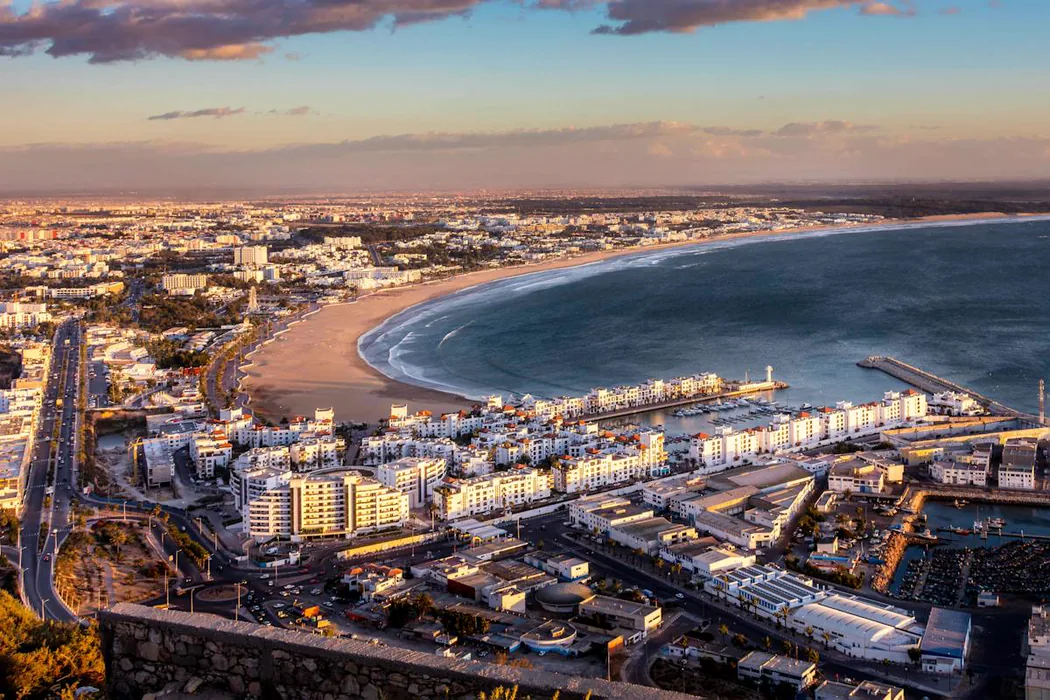
This is the one bit of marketing we’ll own: Imsouane is, for our money, the best solo base on the Moroccan coast, and we think it beats Taghazout for solos specifically.
Taghazout is the more famous surf town. It has more camps, more bars, a bigger nightlife, and more international footfall. For some travellers that’s a plus. For solo travellers, it comes with friction:
- Taghazout is big enough that you’ll walk alone at night sometimes, and the streets are busier and less walkable than a village’s.
- Camps in Taghazout tend to be larger and more rotational — higher guest turnover means less time to bond.
- The bar scene pulls group energy outside the camp’s communal space, so the “at the camp” hours are thinner.
Imsouane flips all three. It’s small enough that you walk between camps, cafés and the Bay in daylight with people you already know. Camps are smaller, so the group you meet on Monday is still there on Friday. There’s no bar district to pull people away, so the camp terrace is where evenings happen — which is exactly where a solo traveller wants to be.
For the full head-to-head, our Imsouane vs Taghazout comparison goes into wave quality, crowds, nightlife, and cost. For solo-specific purposes: Imsouane wins.
A solo traveller’s typical week
If it helps to see the shape of it:
- Day 0 — Arrival. Pre-arranged transfer picks you up at Agadir airport. Two-hour drive up the coast. Arrive at the camp late afternoon. Drop your bag, take a shower, come down for dinner. You’ll meet two or three other guests before the plates arrive.
- Day 1 — First session. Beach theory in the morning with the group. Lunch at the camp. Afternoon session at the Bay. Sunset on the roof. Dinner. By now you know every name at the table.
- Day 2 — First wave. Your instructor pushes you onto a proper wave. You ride it. Someone films it on their phone. It becomes the story at lunch. You feel part of the group suddenly.
- Day 3 — The lock-in. There’s a rhythm now. You have a favourite spot at the breakfast table. You know whose coffee order to grab if you’re walking past the café.
- Days 4–6 — The best stretch. Sessions improve. Someone organises an extra sunset walk to the port. A private joke forms. You stop checking your phone.
- Day 7 — The last dinner. People exchange Instagrams. Someone cries a bit. You book next year.
For a deeper hour-by-hour breakdown, our first week at a beginner surf camp in Morocco piece is the long version of the above.
Booking a solo surf camp Morocco trip: what to actually ask
When you enquire at a camp, send these questions:
- How many guests are you expecting that week, and what’s the typical gender and age mix?
- Is there a single supplement on private rooms? If so, how much?
- Are airport transfers included, and who drives — the camp’s own driver or an outside service?
- How are surf groups formed — by ability, randomly, or a mix?
- What’s the refund policy if I can’t travel at the last minute?
- Are dinners communal, and if so, how many per week?
A camp’s answers to these six questions will tell you more than a homepage ever will. A vague or evasive answer to question 1 or 6 is a red flag for solos specifically.
The honest Olas pitch
We keep groups small — typically under ten guests at once. Rooms range from shared dorm to private with en-suite. Dinners are communal every night except one. Airport transfers are our driver, not an outside service. We mix surf groups across ability, and we push solos toward pairing with someone of a similar level for buddy-safety in the water. Imsouane is the village around us. The full camp page has the specifics.
If you want the broader context on how to weigh one camp against another, our pillar guide to surf camps in Morocco lays out the full framework, and the family surf camp guide is useful if part of you is wondering about a trip with a sibling or parent instead.
FAQ
Is Morocco safe for solo female travellers?
The UK Foreign Office flags that women may face unwanted attention, particularly when travelling alone, and advises loose-fitting clothing, avoiding quiet areas after dark, and pre-arranged transport over street taxis. Inside a surf village like Imsouane, with pre-arranged airport transfers and a walkable camp-to-break routine, solo female travellers generally have safe, sociable weeks. Apply normal situational awareness, rely on the camp host, and you’ll be fine.
Is it awkward to go to a surf camp alone?
Almost never, if the camp is set up for it. A small group (4–10 guests), a communal dinner table, and shared transport to the waves mean you’ll know every name by the end of night one and have people to eat with every evening. The activity is the social glue — surfing together bonds people fast. Solos regularly report it’s the most connected week they’ve had in years.
Should I stay in a dorm or a private room as a solo traveller?
Dorm if you want to meet people faster and save money — you’ll bond with roommates before dinner on night one. Private room if you’re a light sleeper, need decompression time, or are comfortable with meeting people at meals rather than in shared quarters. Most camps offer both, and the group social forms at the table either way. First-time solo travellers often prefer dorm; seasoned solo travellers often prefer private.
What’s the best surf camp in Morocco for solo travel?
Any camp with a small guest count (under about 10 at peak), communal dinners, pre-arranged transfers, and a village-walkable setting. Size matters more than location. Imsouane-based camps tend to suit solos better than Taghazout’s larger rotations because the village is walkable and the group you meet on day one is still there on day seven. Read recent reviews specifically for the word “solo” before you book.
How big should the group be at a solo-friendly surf camp?
Four to ten guests at peak is the sweet spot. Smaller than that and the camp’s social scene depends on luck — if two of the other three people don’t click with you, you’ve got an awkward week. Bigger than about twelve and solos tend to get absorbed into the background, at a long table where cliques form by day two. Ask the camp directly what the expected guest count is for your chosen week.
Can beginners go to a Morocco surf camp on their own?
Absolutely — in fact, a majority of solo guests are total beginners, and a good camp is built for exactly that combination. Imsouane Bay is a famously forgiving wave, instructors teach from zero, and you’ll be in a learner group with a handful of others at the same level. Travelling alone as a first-time surfer is not a handicap. It’s a clean slate, which is the best way to learn anything.
Ready to plan it?
If this has convinced you, you can see current availability and solo-friendly room options on our booking page, or read what a full camp week looks like on our surf camp overview. If you want the broader Surf Camp Morocco context first, the digital nomad surfing Morocco piece covers a close-adjacent solo audience — remote workers who turn a surf week into a surf month.
0 Comments