

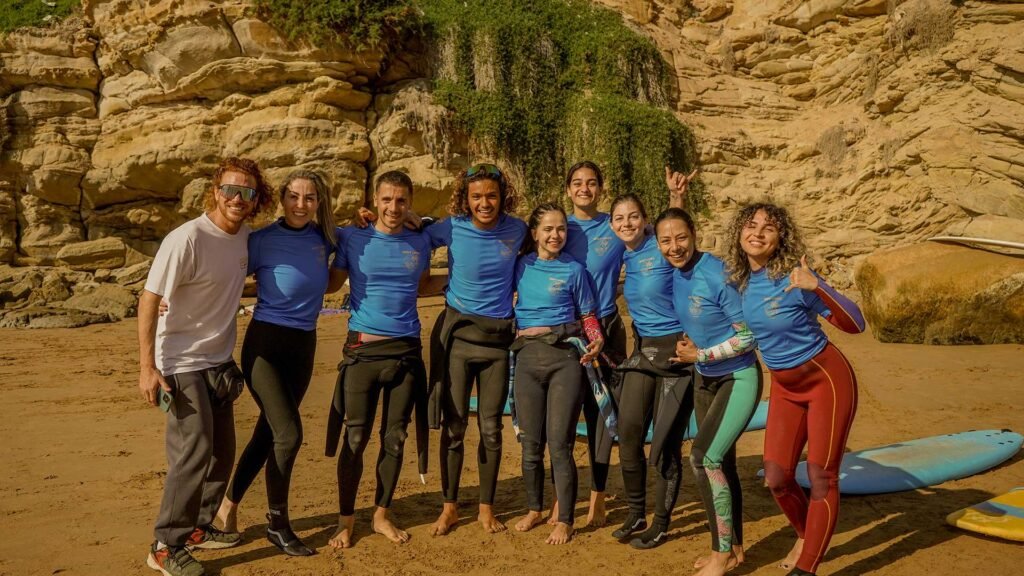
This Olas Surf Camp review is written by the people running the camp — disclosed upfront, because that’s the honest framing. It’s not an independent review and we’re not pretending otherwise. What it is is the most specific account we can give of what actually happens during a week at Olas in Imsouane: the rhythm of the days, the food on the table, the walk to the Bay, the rooftop at sunset, the people who keep turning up, and the short list of travellers we think shouldn’t come here. If you’re trying to picture the week before you pay for it, this is the page we’d want you to read.
Every surf camp website in Imsouane sells its amenities. Almost none of them sell you the actual feeling of the week — the quiet, the tiredness, the food-coma nap after the second tagine of the day, the way you stop looking at your phone by Tuesday. That’s what this piece is for. If after reading it you think “yes, that’s exactly the week I want,” our booking page is two clicks away. If after reading it you think “no, that’s not me” — we’d rather you figure that out now than in arrivals at Agadir.
Day 1: You arrive, you’re fed, you sleep
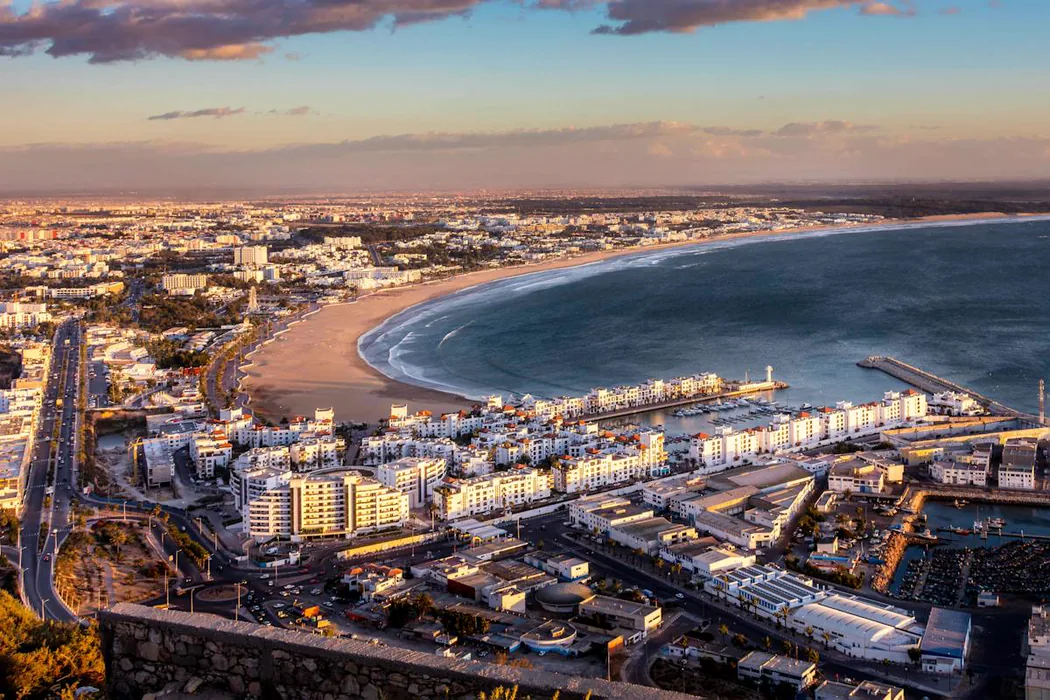
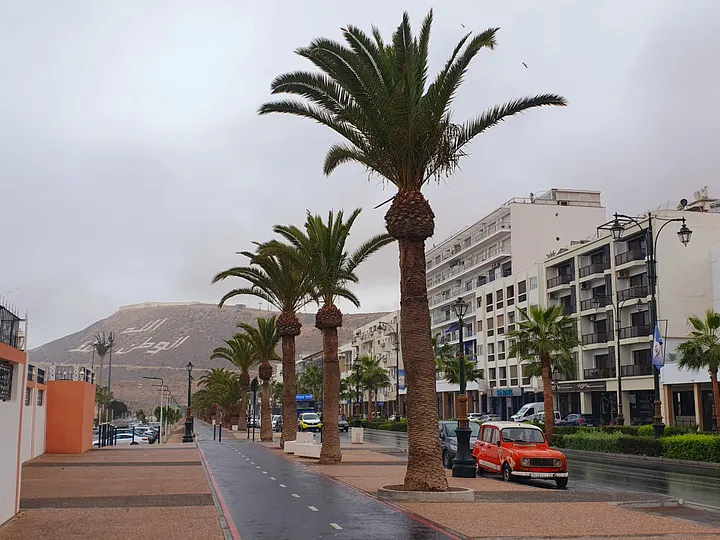
Most guests land at Agadir Al Massira (AGA). From there it’s a two-hour private transfer north up the coast — roughly €60–€100 depending on the car and whether you’re sharing. The road climbs out of Agadir, flattens along the argan plateau, then bends west back to the sea. You won’t see Imsouane until the last five minutes, when the village drops into view below the cliffs — a white cluster of houses, a working fishing port, and a bay the shape of a fishhook.
By the time the car pulls up at the camp, you’ve been travelling for most of a day. We don’t throw a welcome orientation at you. We show you your room, hand you water, and tell you dinner is in an hour. Most first nights are a tagine — slow-cooked, shared, with bread from the village bakery that was warm two hours ago. You eat with whoever else arrived that day. You meet people you’ll be surfing with tomorrow. You sleep deeply because the village is quiet after 10pm, the sea is ten minutes’ walk away, and the bed is actually a bed — not a bunk, unless you chose the dorm.
That’s Day 1. No surf. No schedule. Food, a bed, and the sound of the port going to sleep.
Day 2: The first wave, the first lunch, the first nap
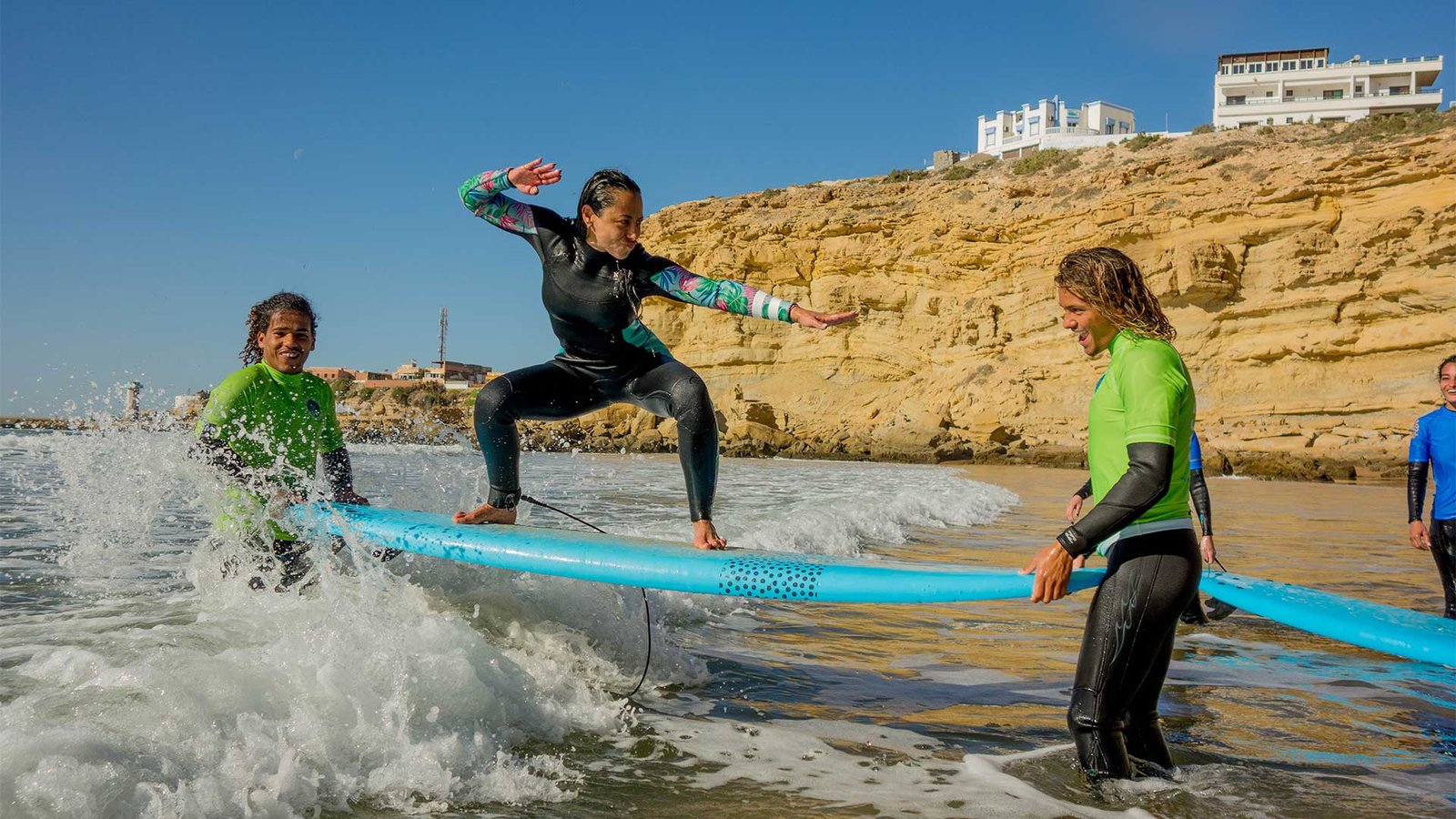
Breakfast is usually at eight — coffee, fresh bread, eggs if you want them, olives, local jam, a small dish of cheese. You eat on the roof if the sun is up, which in most months it is. Then beach theory: your instructor walks your group through paddling, pop-up, positioning, and the line-up etiquette that the Bay expects from you. Nothing heroic. The Bay is a forgiving wave for beginners — one of the reasons we built here. For the full wave mechanics, see our Imsouane Bay guide.
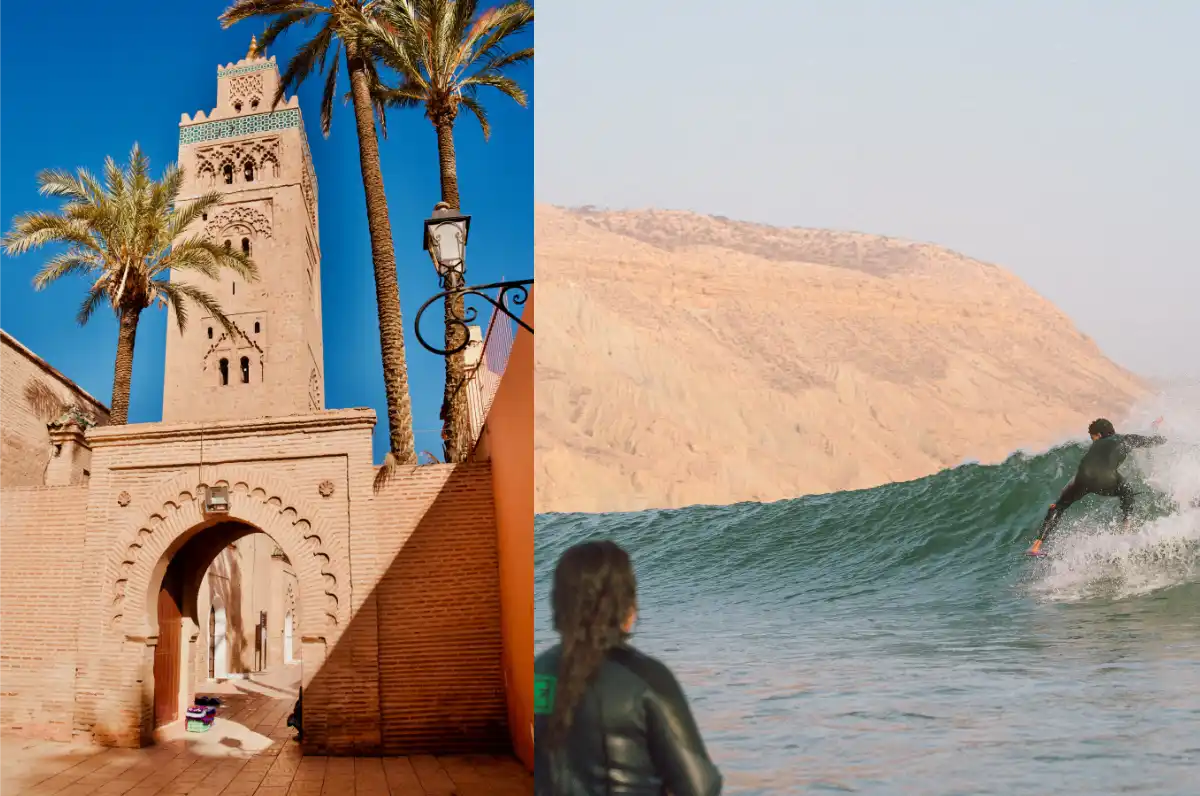
Your first paddle-out is usually inside, on the shoulder, on a soft-top board. You’ll catch a white-water wave in the first twenty minutes. You might stand on one before the session ends. The session is typically 90 minutes to two hours. You come back tired in a way that office-tired never quite matches — shoulders, legs, core, salt in your ears.
Lunch is the surprise. It’s not a hotel lunch. It’s a family-style table — another tagine, or a grilled fish from the port if the boats had a good morning, or a Moroccan salad spread (tomato, cucumber, cumin, olives, preserved lemon). You sit down at 1:30pm, you get up at 3pm, and by 3:15pm you are horizontally asleep on your bed. This is not a weakness — everyone on their first surf day does the same thing. By Day 4 you start to recognise the shape of your own body’s tiredness and you plan the nap on purpose.
Afternoon session — lighter, shorter, or skipped entirely if the wind has turned. Then the rooftop.
The rooftop ritual
Here’s a thing that happens at Olas that we didn’t design on purpose but which now runs the week: people end up on the rooftop at sunset. Every evening. By Day 3 you’ll recognise the same six faces up there at six o’clock, mint tea in hand, sometimes a beer, watching the light go from gold to pink to grey over the Atlantic.
The tea is the part to pay attention to. Moroccan mint tea is poured high from the pot to aerate it, and it’s sweetened heavily by tradition — your first glass will taste like a dessert. By the end of the week you’ll be the one pouring it for the person who just arrived. Nobody plans this. It just happens. The roof looks west, the sun sets into the Atlantic, and there is nothing else to do at 6pm except watch it. Phones stay in pockets. Nobody photographs every sunset after the second one.
This is the ritual that the brochure cannot explain. It is also the hour at which most of the friendships of the week actually form.
The people you end up with
The mix shifts every week, but the pattern is remarkably stable. In any given Olas week you’ll typically have: two or three solo travellers (mostly solo women, actually — see our solo surf camp guide for why Imsouane works for solo travel), a couple in their thirties trying something different for their annual break, one or two digital nomads who booked a week and quietly extended to three (the nomad angle has a separate piece of its own), sometimes a parent with a teenager, and once or twice a year a van-lifer who was passing through and decided a bed and a hot shower for seven days sounded great.
What this does not look like: a hen party, a stag do, a corporate retreat, or a festival crowd. The camp is small on purpose — communal dinners for roughly four to ten people most nights — and the size is what makes the lock-in work. By Day 3 you know everyone’s name. By Day 5 you have inside jokes about the one person who keeps falling off the same wave. By Day 7 you are exchanging Instagram handles and making half-serious plans to meet again next autumn.
If the idea of eating dinner at a long table with six strangers on the first night is your idea of a nightmare, Imsouane will be uncomfortable for you. If it sounds like exactly the holiday you’ve been trying to find for ten years, you are our person.
Food: real food, not hotel food
This one matters and we want to be specific. The food at Olas is what a Moroccan family cooks for themselves when there is time and the market was good — which in Imsouane it always is, because the fishing port is a three-minute walk down the hill and the vegetable suppliers come through twice a week.
A typical week on the table:
- Tagines, plural — chicken with preserved lemon and olives, lamb with prunes, vegetable with argan oil, fish with chermoula. The pot is slow-cooked for hours and served with the lid lifted at the table.
- Grilled fish from that morning’s port catch — sardines, sea bream, sometimes a conger if the boats did well.
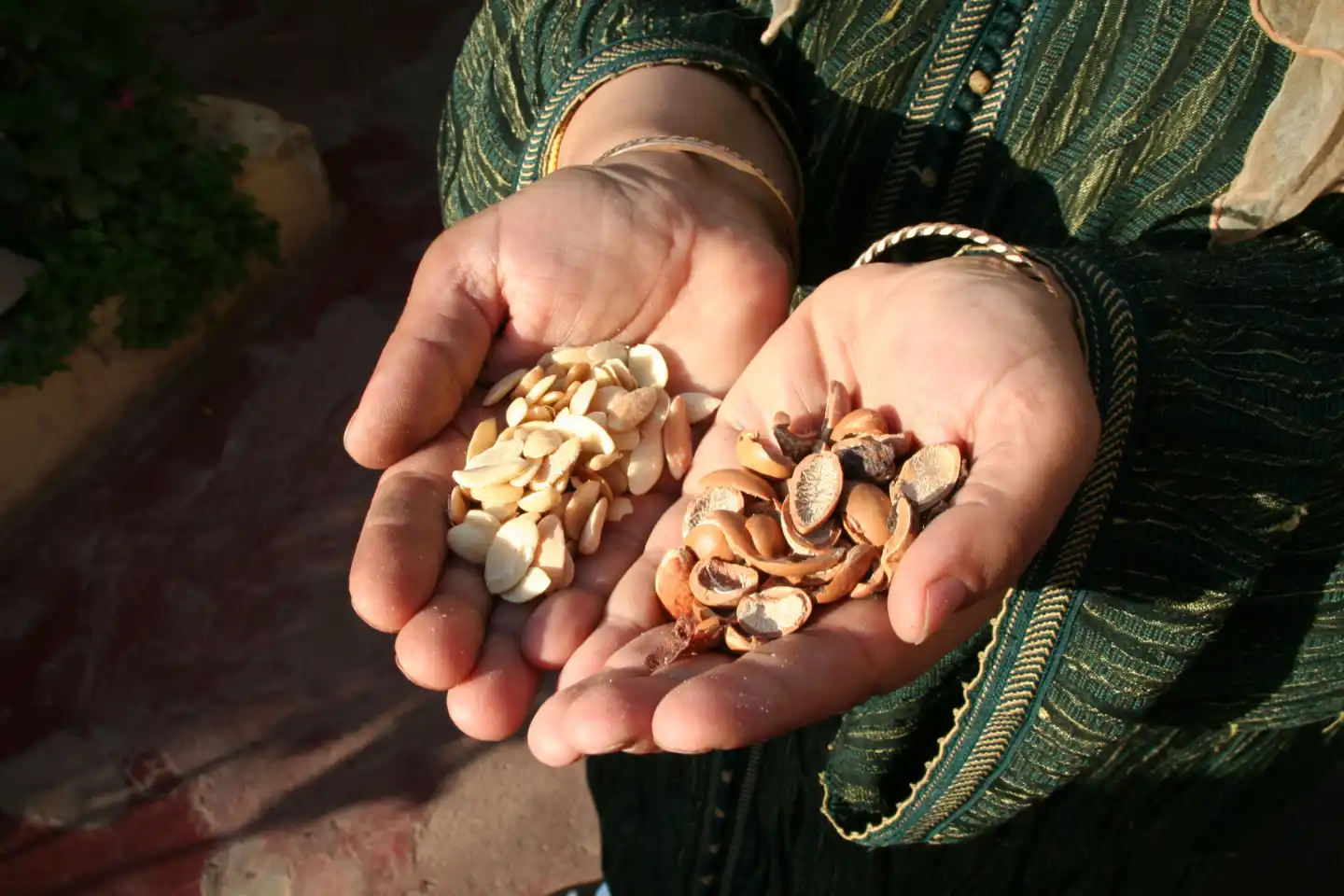
- Moroccan breakfast spread — msemen (flaky flatbread), amlou (an argan-almond-honey paste that will ruin supermarket spreads for you forever), olives, a soft cheese, eggs to order, strong coffee.
- Couscous on Fridays — the traditional big midday dish of the Moroccan week, vegetables stacked on top, broth poured over.
- Salads — not iceberg-lettuce fillers. Tomato-and-red-onion with cumin, carrot-and-orange with cinnamon, beetroot with garlic, zaalouk (smoked aubergine).
- Bread from the village bakery, baked in a wood oven that morning.
- Fruit — whatever is in season: oranges, bananas, pomegranate in autumn, dates year-round.
On dietary notes: the food is halal by default, which for most travellers is a neutral dietary fact — if you don’t eat pork this is already your world, and if you do, just know it’s not served. Vegetarian and vegan guests we accommodate easily — the vegetable tagines and salad spread mean the standard menu is already 60% plant-based. Strict coeliac is harder and needs a heads-up at booking so the kitchen can plan around the bread.
What you will not find on the table: a breakfast buffet with eight kinds of pre-packaged croissant. A lunch sandwich. A dinner that arrived frozen. The food is the reason a lot of people book a second year.
The walk to the Bay
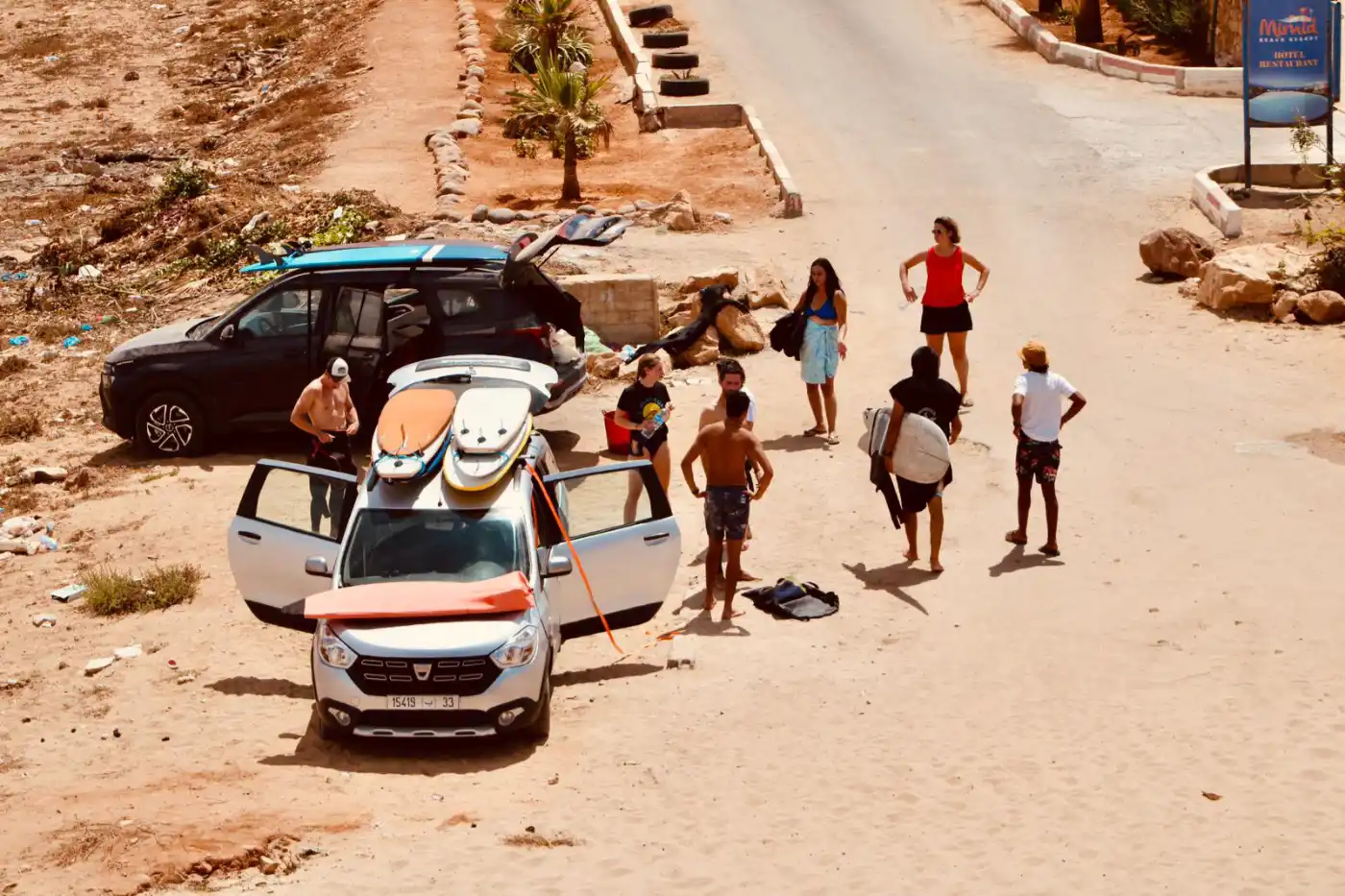
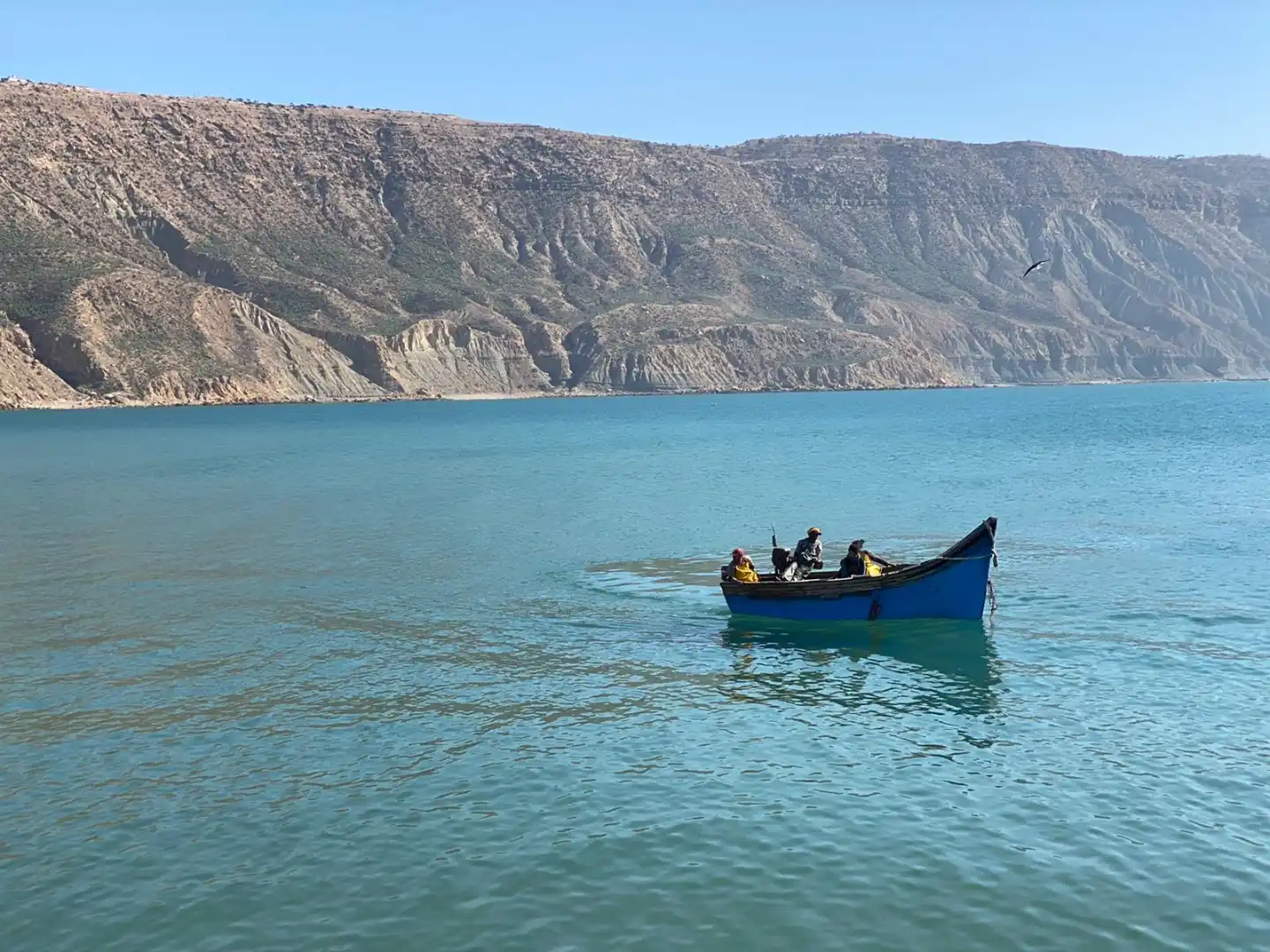
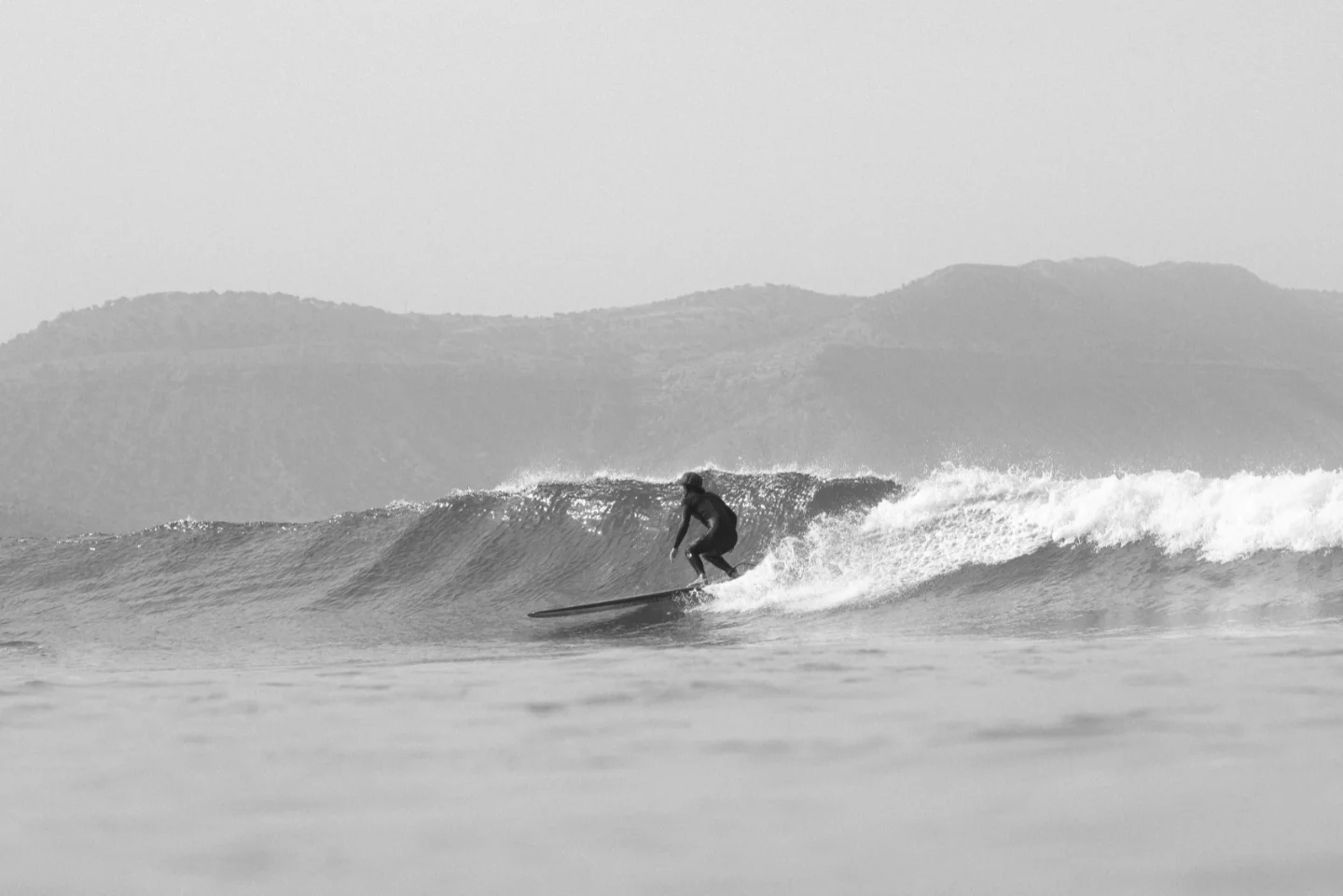
Five minutes on foot. Board under one arm, wetsuit half-zipped, sandals kicking up dust. Down past the camp gate, left along the village road, past the bakery, past the small shop where you buy bananas for after the session, past the path that drops down to the fishing port (where, if you time it right, you’ll see the small blue boats unloading that morning’s catch). Then the road bends and the Bay opens up in front of you — the headland, the long right-hander peeling for three to five hundred metres at its best, the line-up already dotted with other surfers.
On a good day the first glimpse of the wave stops you walking for a second. On an average day you just keep moving and paddle out. The point is that the walk itself is part of the rhythm of the week — you do it twice a day, sometimes three times, and by Day 4 you’re doing it without thinking. This is a thing Imsouane has that most surf towns don’t: everything is walkable. You don’t get in a van. You don’t drive anywhere. The wave is where you live. For comparisons on how Imsouane differs from other Moroccan surf towns in this regard, we covered it in Imsouane vs Taghazout.
Olas Surf Camp review: what surprises people
Across several years of running weeks here, the same surprises come up from guest after guest on the last night. They’re worth naming.
- The quiet. Imsouane is not a town with a nightlife. There is no club, no pub crawl, no 2am anywhere. Most guests are in bed by 10:30pm by Day 3 because they’re actually tired.
- How long the wave is. Guests who’ve surfed in Portugal, Cornwall, France, or Bali are not ready for a 300–500 metre ride. On your best wave of the week, you will catch a long-period ride that genuinely makes your legs give out before the wave does.
- How tired you are by Day 3. Surfing uses muscle groups your desk job does not. Afternoon naps stop being a choice and become a scheduled event.
- How much you sleep. Nine hours a night is common. Ten is not unheard of.
- How little you use your phone. Wi-Fi works fine at the camp. You just stop opening things. By Day 4 most guests check their phone twice a day.
- How cheap everything is outside the camp. A coffee in the village is 10–15 dirhams (about £0.80–£1.20). A bowl of harira soup at a village café is about £2. A full plate of grilled sardines at the port is about £4.
- How good the tea is. The mint tea is genuinely as good as the food. By Day 5 you’ve asked how it’s made.
Olas Surf Camp review: the honest “who shouldn’t come here”
We said we’d be direct about this, so here it is. These are the guests who, in our experience, do not have the week they hoped for at Olas:
- Nightlife-first travellers. If your holiday priority is bars, clubs, or a party scene, Imsouane is the wrong village. You want somewhere bigger — Taghazout or Essaouira, and probably not a surf camp at all.
- Strict-luxury travellers. Olas is a comfortable, clean, well-run camp. It is not a five-star resort. Hot water works, rooms are good, the roof terrace is genuinely lovely — but there is no spa menu and the pool is the ocean. If your baseline is a Four Seasons, this won’t clear the bar.
- People who need total silence. The village has roosters. The harbour starts early — boats go out before first light, and they are not quiet about it. Most guests find the ambient sound calming after Night 2. A few don’t. Be honest with yourself before booking.
- People who need guaranteed head-high waves every day. Imsouane is mostly a mellow, forgiving wave — which is its strength for 80% of guests. If you’re a confirmed advanced surfer chasing punchy, overhead point breaks every morning, Anchor Point in Taghazout is a better base for you.
- Travellers who hate shared meals. Dinner is communal most nights. If that sounds like a chore rather than a pleasure, we are a poor fit.
That’s it. Everyone else — solos, couples, small friend groups, first-time surfers, intermediates, digital nomads, parent-and-teen duos, couples where one surfs and one reads on the roof — we’ve hosted versions of every one of those and they’ve left happy.
Day 7: The last dinner
By Day 7 a few predictable things are happening. The group that arrived on the same day is now eating at the same end of the table without thinking about it. People are exchanging Instagram handles. Someone is quietly checking next November’s availability on their phone during dessert. The instructor who put you on your first wave on Day 2 gets thanked properly, often awkwardly, by someone who has surprised themselves at what they can do now.
The last dinner is usually a bigger tagine than the first — a ceremonial one, served with more bread, a bit more time at the table, and whoever on the staff has a guitar brings it out. It’s not organised. It’s the accumulation of a week of the same people eating at the same table.
The next morning is the transfer back to Agadir. Usually at least one guest is re-booking for next year before the car leaves.
The logistics, plainly
For the practical side of the week, here is what you actually need to know:
- Rooms: dorm (shared), shared twin, and private double configurations. Most solo travellers choose dorm or shared; most couples choose private.
- What’s included: accommodation, all meals, surf coaching, board and wetsuit rental, beach transfers where needed, and the roof terrace.
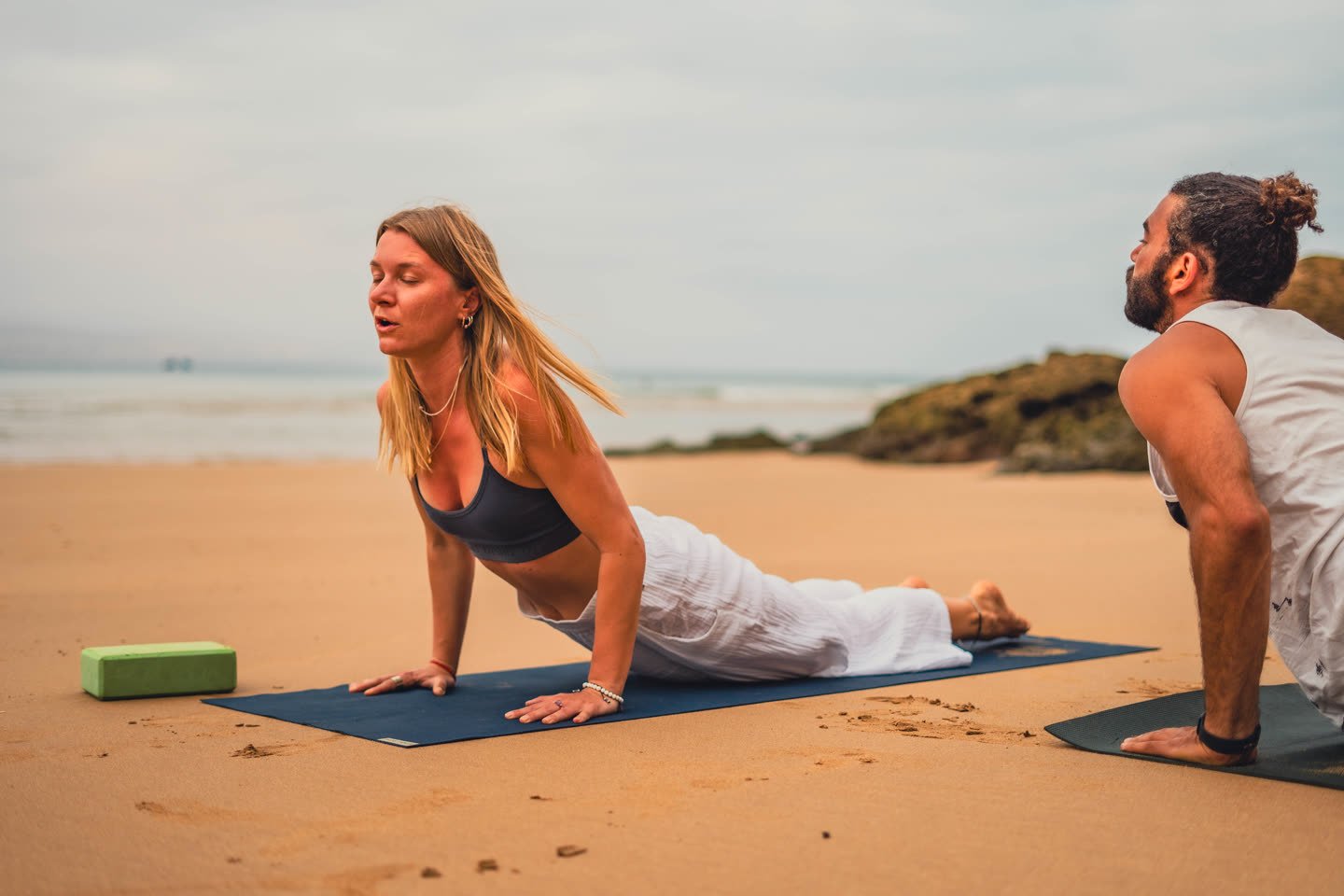
- Packages: the standard surf camp week is the all-inclusive option; surf and stay is the B&B + surf option for guests who want more flexibility on meals; a separate surf-and-yoga package runs on set dates (see our surf and yoga retreat guide).
- Transfer: Agadir Al Massira (AGA) is the nearest airport. We can arrange the 2-hour private transfer for you at a fixed price — arrange it at booking, not on landing.
- Dates: we run weeks year-round. Peak season is October through March. December sells out earliest because of Christmas and New Year traffic — if December is your target, book by early autumn.
- What you don’t need to pack: board, wetsuit, leash, wax. These are all at the camp.
- What you do need to pack: reef-safe sunscreen, rash vest, flip-flops, a warm layer for the evenings (the village cools down after dark, especially November–February), and a book.
First-time surfers in particular might find our first-week-at-a-beginner-surf-camp-Morocco piece useful — it’s the generic version of what this page is the Olas-specific concretion of.
FAQ
What does a week at Olas actually include?
Seven nights of accommodation (dorm, shared, or private), all meals (breakfast, lunch, dinner), surf coaching and sessions, board and wetsuit rental, and communal use of the roof terrace and common areas. Airport transfers from Agadir are arranged separately at a fixed price. Extras like the surf-and-yoga package or longer itineraries can be added at booking.
Can beginners come to Olas Surf Camp?
Yes — beginners are the largest single group we host. Imsouane Bay is one of the most beginner-friendly point breaks in Africa. Beach theory, soft-top boards, and small-group coaching mean most first-timers stand up within their first two or three sessions. You do not need to have surfed before.
Who shouldn’t come to Olas Surf Camp?
Travellers whose holiday priority is nightlife, five-star luxury, total silence, or guaranteed advanced-level surf conditions every day. Imsouane is a quiet working fishing village with a forgiving wave; our camp is comfortable but not resort-grade; and communal dinners are part of the experience. If any of those is a deal-breaker for you, we are honestly not the right fit.
How do I get from Agadir airport to Olas in Imsouane?
The fastest option is the private transfer we arrange at booking — typically €60–€100 and about two hours of driving up the coast road. A shared transfer is sometimes possible if other guests are landing on the same day. Self-drive is possible but most guests find handing the logistics over worth the price, especially on arrival day.
When should I book Olas Surf Camp for the best week?
For peak-season swell, October through March is the window. December in particular is worth its own planning — see our Imsouane in December piece. For summer, June through September is mellower, warmer, and better for true beginners who want smaller waves. Book 2–4 months ahead for peak-season weeks; last-minute availability is usually easier in the shoulder months.
Olas Surf Camp review: a last word
What we’ve tried to do on this page is describe the week honestly enough that you can decide without a sales pitch. If the rhythm of it — the roof at sunset, the walk to the Bay, the long table, the tired afternoon, the slow build of a small group of strangers into the people you’ll remember the year by — sounds like the holiday you’ve been trying to find, we’d love to have you. You can check dates and packages on our booking page, read the service-specific detail for the full surf camp week or the more flexible surf and stay option, and if you’ve already got a specific week in mind, message us directly — we answer the enquiry inbox ourselves.
If after reading this you’ve decided Imsouane is not for you, that is also a good outcome. Better now than at arrivals. Either way, thanks for reading the long version.
0 Comments