
Figuring out how to choose a surf camp in Morocco is a problem every first-time buyer runs into: eight open browser tabs, identical smiling-instructor photos, identical “perfect wave for every level” paragraphs, and no obvious way to tell the actually-good camps from the slick-marketing ones. A pretty website is table stakes, not a filter. This is the checklist we wish every first-time Morocco surf buyer had on the first tab, not the last one.
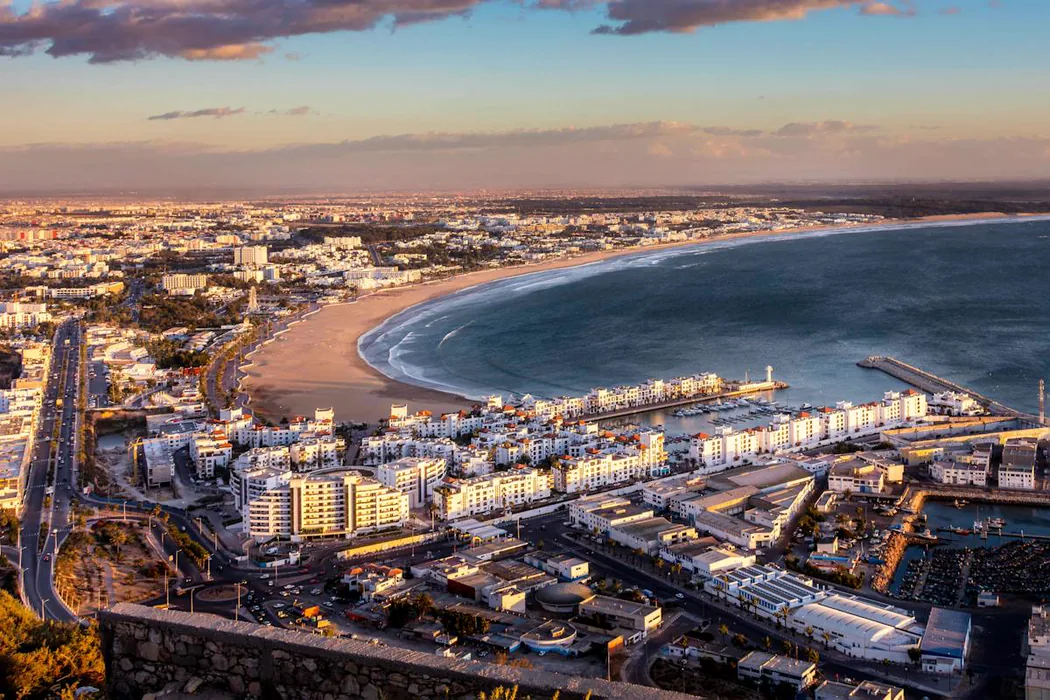
A disclosure up front: we run a small surf camp in Imsouane, on the Atlantic coast about two hours north of Agadir. So we have a bias. What we are about to tell you is still honest, because the people we most want to host are the ones who booked with their eyes open. The ones who arrive with the wrong idea tend to leave frustrated, and everyone loses that week. The seven questions below, plus the red-flag list at the end, are how we would screen a camp if we were buying, not selling.
If you want the category-level view of what a Moroccan surf camp actually is — towns, seasons, who it suits — start with our complete Morocco surf camp guide. This post is the buying checklist that sits underneath it.
How to choose a surf camp in Morocco: know your own level first
Most surf-camp bookings that go sideways in Morocco go sideways for one reason. Someone booked a camp that was right for the person they imagined they were, not the person they actually are on Monday morning, in cold Atlantic water, on a rented board.
Be honest about where you sit on this scale, because every question that follows depends on it:
- Never-ever. You have never stood up on a surfboard, or you stood up once on a soft-top at a beach holiday and that was four years ago. You need a camp with a proper beginner beach, soft-top boards, and an instructor in the water with you for the whole session — not a camp whose website shows Anchor Point barrels.
- Once or twice. You have taken a few lessons, you can sometimes pop up, you cannot yet paddle out to a reef without help. You need a camp that distinguishes improvers from first-timers and does not put you in a group of absolute beginners for the whole week.
- Can paddle out. You catch unbroken waves on your own at least some of the time, you can duck-dive or turtle-roll a board, you understand priority in a lineup. You need a camp that will take you to a real point break and coach technique, not shepherd you at a whitewater beach.
Before you even ask the questions below, Surfline’s surf-basics guide is a decent 10-minute sanity check on what level you actually are — most over-claimers realise something while reading it. If you are between levels, round down, not up. A camp can move a fast learner up on day three. A camp cannot easily drop a booking you oversold from an intermediate group back to beginners without making your week awkward. This single honesty call is worth more than any question below. If you want the broader beginner primer, our Morocco surfing beginner’s guide walks through the fitness, the equipment, and the first-wave mechanics in full.
Q1: Who are the instructors, actually?
The answer you want is a list of names, a line about years coaching, and a mention of certification. The answer you do not want is “our experienced team of passionate surfers”.
Three things to press on:
- Certification. The recognised global track is ISA (International Surfing Association) instructor-level qualification. ASI (Academy of Surfing Instructors) is the other. Both require water-rescue training, first aid, and a coaching assessment. “Has been surfing for ten years” is not the same thing as “has been coaching for three years” — you want the second one.
- Years coaching, not years surfing. A 23-year-old local who grew up on the reef is a spectacular surfer and possibly a mediocre teacher. Ask how long the instructor has been teaching specifically.
- English fluency — really. European surfers book Morocco assuming English in the water. In most camps it is fine. In some it is not, and nothing ruins a session faster than “push up now” landing half a second after the wave. Ask for a quick video or voice note from the lead instructor if you are booking blind.
A camp that will happily share its instructors’ names and coaching CVs on request is a camp that has nothing to hide. A camp that replies with a paragraph of adjectives is a camp that hopes you will not ask again.
Q2: What is the real group size, at the peak week of the year you are booking?
Every camp in Morocco lists a group-size ratio. Six-to-one. Eight-to-one. “Small groups”. That headline number is often the average across the year, not the reality of the week you just booked.
Three prices roll into this question:
- Average group size. The number on the website.
- Peak-week group size. The number when the camp is fully booked in October, February, or Easter. Ask for this number specifically.
- Cap. The ceiling they will never go above — the hard maximum per instructor per session. If the camp cannot tell you this number, they do not have one.
At Olas we run 6:1 as a firm peak-week commitment, not an average. That means at fully-booked October weeks, our instructors still have six guests per session, not ten. The reason we can is that we cap our total weekly intake to match. If a camp can scale up intake without a matching cap on instructor hires, the ratio will quietly inflate when you arrive.
A 10:1 ratio is not automatically bad, incidentally. It is fine for improvers who mainly need a spotter and someone to call waves. For a true first-timer, anything above 6:1 means some of your week is going to be spent watching an instructor work with someone else while you sit on the sand. Know what you are buying.
Q3: Do they move you to match the wave, or keep you on one beach all week?
There are two kinds of surf camp in Morocco. The first keeps you on one home beach for the whole week. The second moves you daily to match the wave — Anchor Point if it is firing, the Bay at Imsouane if it is small and clean, a beach break if the point is too big.
Both models can work. The question is which one matches your week.
A fixed-beach camp works if you are a genuine beginner: predictable whitewater, the instructor knows the sandbar, no stressful drives, and your skill builds cumulatively on the same setup. A fixed-beach camp fails if you are an improver and the spot goes flat for three days — your week evaporates.
A wave-hunting camp works if you are past whitewater and want to surf what is actually on that day. It fails if you are a first-timer who ends up dropped into a challenging beach break because “the swell moved”.
The Imsouane angle, for context: the Bay itself is long and forgiving enough that a fixed-base setup works for most levels most of the time — it handles big swell by cleaning it up, and it handles small swell by still producing a ride. That is part of why we picked it. Our Imsouane vs Taghazout comparison goes deeper on this if you are weighing the two regions.
Q4: What is the refund or weather policy when swells do not land?
Here is where we break from most camp-blog framework posts on this topic. Most of them tell you to ask for a weather refund policy. We will tell you the truth instead.
No serious surf camp in Morocco refunds you for flat weeks, and we do not either. The Atlantic does what it wants. Anyone promising “guaranteed waves” or a money-back weather clause is either lying or pricing the bluff into the package — you are paying for the insurance whether or not you claim it.
The honest question is not “will you refund me”. It is “what will you do if the forecast collapses”. That is a question a good camp can answer clearly. The answers you want to hear are:
- We move the group to a sheltered or secondary spot that works in small/wrong-direction swell.
- We run extra theory, video-feedback, and pool or whitewater technique sessions.
- We do not hide — the instructors are still with you at the scheduled times, whether the waves are head-high or ankle-high.
The answers you do not want are silence, a brochure line about “yoga options”, or a free transfer to a souk as the entire Plan B. Those are signs the camp has no wet-weather playbook and will leave you to entertain yourself.
Q5: How do they assess your level before you arrive?
A camp that asks no questions about your level is telling you something. It is telling you that group placement will happen on the beach on Monday morning with a five-minute chat, and you will end up wherever there happens to be space.
Good signs: a booking form that asks for your level on a multi-option scale, a follow-up email asking how many sessions you have had in the past year, or a WhatsApp clip request for intermediate-and-above bookings.
We should say plainly what we do at Olas, because it is a little different: we do not ask intermediate bookers for video proof. We trust you. Our booking form asks you to pick your level, we read the answer, and we believe it. The reason is partly that Imsouane’s Bay is forgiving enough that a slight over-claim is not dangerous, and partly that we would rather treat adults like adults than ask them to film themselves.
The flip side of that trust is on you: if you tell us you can paddle out and you cannot, your week will be harder than it needs to be. Round down, not up. A camp that can tell you, in one sentence, what their level-assessment process is — even if it is “we trust what you tell us” — is a camp that has thought about this. A camp that shrugs has not.
Q6: What does the food actually look like?
Food is the most under-asked question on surf-camp forms and the one guests talk about the most afterward. A rough spectrum of what you will find in Morocco:
- Moroccan home-cooked. Tagines, couscous on Fridays, lentil soups, fresh bread, mint tea on a rotation a local family would eat. This is what we serve at Olas, because we live here and this is what we eat.
- Tagines-on-repeat. Same three tagines, beef Monday, chicken Wednesday, vegetable Friday, for twelve weeks. Edible but dull by day five.
- Euro-hotel buffet. Pasta, pizza, stir-fry, generic salads. Acceptable if you have a picky group, depressing if you came for Morocco.
- Self-catering. A kitchen and a list of the nearest shops. Fine if that is what you booked. Not fine if you thought dinner was included.
The specific questions to ask: is breakfast daily or just three days a week? Are dinners included seven days or five (most camps close Sunday)? Can you see a sample week’s menu? How do they handle vegan, vegetarian, halal, gluten-free — with a single question on the booking form, or by handing you an apology on day one?
If the reply is evasive, the food will be too. If they send you a real photo of last week’s dinner table, they are proud of it.
Q7: Who else will be staying the week you book?
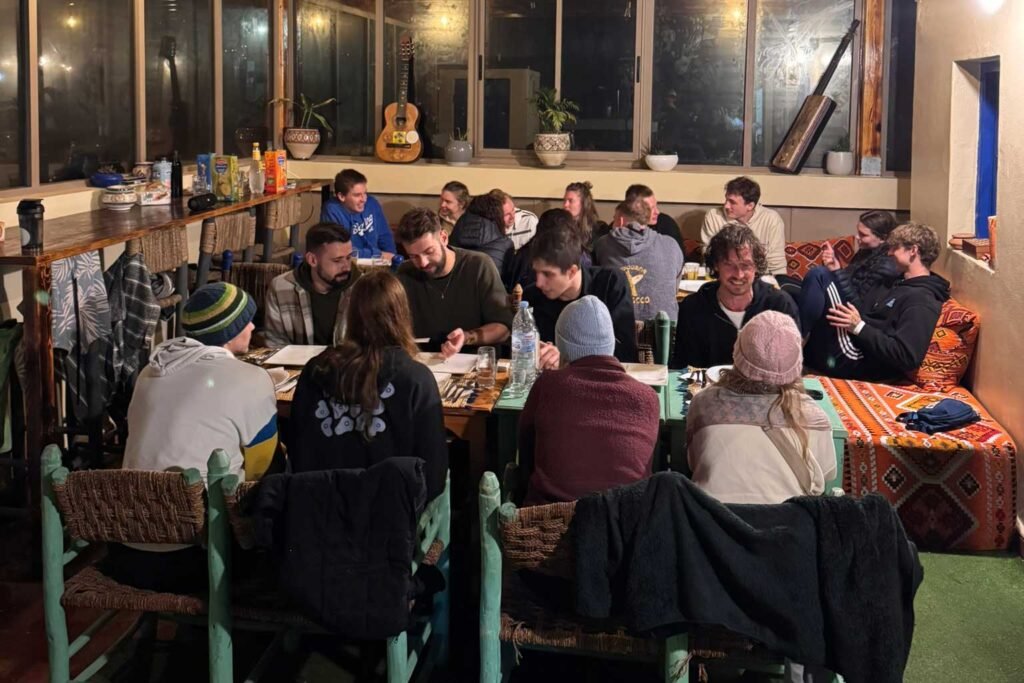
The social mix of a surf-camp week is the second thing guests remember after the waves. A 22-year-old-party-hostel week and a 38-year-old-retreat week are not the same product in the same building — they are completely different experiences, and some camps alternate between them depending on the season without telling you.
Honest questions to ask:
- What is the age range of guests booked for my week so far?
- What is the solo/couple/family/group split?
- Is there a dominant nationality — for example, a booked-out Scandi corporate retreat week where the rest of you will feel like guests at someone else’s offsite?
- Is this week likely to be quiet or busy overall?
Off-season Morocco (late May through August, small waves, beginner conditions) tends to draw a younger, more party-leaning crowd across most camps, including us — we will tell you that if you ask. Peak season (October–March, bigger waves, serious surfers) tends to be older, quieter, and more committed. Neither is better. It depends on what you are after. See our month-by-month Morocco surf guide for how the seasons shape the vibe, and the ISA instructor standards page if you want to sanity-check what “certified instructor” actually means.
If you are a solo traveller anxious about “will there be people like me”, the right answer from a camp is a specific picture of this week’s group, not a stock-photo collage of generic surfers hugging.
How to choose a surf camp in Morocco: 5 red flags to walk away from
If you see any of these on a camp’s site or in the reply to a question, walk away:
- “Guaranteed waves daily.” Impossible. Either they do not understand the Atlantic or they think you do not.
- No named instructors anywhere on the site. A camp that will not name its coaches is a camp that cycles through freelancers. Your instructor on Monday may not be there on Thursday.
- Transfer fees buried deep in the booking confirmation. A camp that does not state airport transfer cost up front is the kind of camp that will add three other things you did not expect.
- No level questionnaire on the booking form. It means you will be sorted on Monday with everyone else, which means the mismatches will happen at your expense.
- All-stock-photo social media. Real camps post blurry phone photos of guests on Friday afternoons. Camps that post only polished drone shots and models on perfect rights are selling an image, not a week.
How to choose a surf camp in Morocco: 5 green flags worth paying for
- A published peak-week instructor ratio cap, not just an average.
- Named instructors with short bios and a named head coach.
- A clear wet-weather Plan B, written down.
- A level questionnaire that asks real questions — how long ago was your last session, what boards have you paddled, do you duck-dive.
- Real, recent, dated photos of the food and the guesthouse, not just lineups.
What we do at Olas, plainly
So you have the checklist. Here is how we answer it ourselves, so you can measure us against the same questions we are telling you to ask.
We are a small camp in Imsouane, on the Bay. We cap our weekly intake so that peak-week ratio stays at 6:1 — we will not book past it. Our instructors are named on the site and certified; the head coach has coached in Morocco for over a decade. We do not move guests beach-to-beach on a daily drive because the Bay itself handles most conditions, from small summer days to overhead winter swells; when it is genuinely flat we run technique and video-review sessions instead of disappearing. We do not refund for weather — the Atlantic is the Atlantic, and we would rather be honest about that than bake an insurance premium into your booking price. We trust you on your stated level; we do not demand a video. The food is Moroccan home cooking, not Euro-buffet. Rooms come in private and shared; you pick.
If that reads like your week, our surf camp page has the full week structure and what is included. The all-inclusive breakdown spells out exactly what falls inside and outside the package, which is the second-most-asked pre-booking question after group size.
FAQ
What is the single most important thing to ask a Morocco surf camp before booking?
The peak-week instructor-to-guest ratio. Not the average — the peak. A camp that will give you a specific number (and a cap they will not exceed) is a camp that has thought about your experience. A camp that quotes only an average is telling you the reality will be worse than advertised in busy weeks.
How do I know if a Morocco surf camp is beginner-friendly?
Three signals: the home beach is a sheltered bay or gentle beach break, not a point or a reef; the instructor stays in the water with beginners the entire session, not just for the push-off; and the booking form distinguishes “never surfed” from “has surfed before” so you are not grouped with people four levels above you. If any of those three is missing, the marketing copy can call itself beginner-friendly all it likes — it is not.
Is a small surf camp better than a big one in Morocco?
For a first trip, yes, in most cases. Smaller camps tend to hold their ratios at peak weeks, know their guests by name, and adapt the schedule when conditions change. Bigger camps have more polished facilities and a larger social pool, which suits some solo travellers better. The real question is not small vs big but whether the camp’s size matches its instructor headcount — a big camp with twelve instructors is fine; a big camp with four is not.
Should I book a surf camp in Taghazout or Imsouane for my first trip?
Honestly, it depends on who you are. Taghazout is louder, more social, more varied on wave options, and has a busier town to walk around in. Imsouane is quieter, has a famously forgiving bay for beginners and longboarders, and is less saturated with camps. We lean toward Imsouane for first-timers because the wave itself is more forgiving, but we will be the first to say Taghazout wins if you are after a buzzing town. Full side-by-side in our Imsouane vs Taghazout post.
What red flags should I watch for when booking a Morocco surf camp?
The top three: “guaranteed waves daily” anywhere on the site (impossible, so they are either lying or unaware), no instructor names published (means a rotating freelancer pool), and no level questionnaire on the booking form (means on-arrival placement, which is where most mismatches happen). Any one of those three is a reason to keep browsing.
How far in advance should I book a Morocco surf camp?
For peak weeks — Christmas, February half-term, Easter, October — book eight to twelve weeks out minimum. Good small camps sell out earlier than you think. For shoulder season, three to four weeks is usually enough. For deep off-season (late May–August), a week or two will do unless you want a specific room type. If you are flexible on dates, messaging the camp directly beats the booking aggregators — most camps will honour their own best rate for direct bookings and you get to ask the seven questions above in the same thread.
One more thing
We would rather you book the wrong camp for the right reasons than the right camp for the wrong ones. Ask the seven questions above of whichever camp is at the top of your list. Ask them of us too — we expect it, and the reply will tell you more about the week you are about to buy than any brochure paragraph. If you are ready, our booking page is the shortest path; if you are still undecided, reply to any of our booking emails with your seven-question checklist and we will answer each one in full. No pressure either way.
0 Comments