
Imsouane Bay is the reason a small fishing village on Morocco’s Atlantic coast keeps turning up on “best surf spots in the world” lists. It’s a right-hand point break that wraps around a natural headland and peels for hundreds of metres on a good day — one of the longest rides on the entire African Atlantic coast. It’s also, unusually, a wave beginners can actually ride. Those two things almost never go together, and this post is about why, how, and what you need to know before you paddle out.
We run a small camp a short walk from Imsouane Bay. We walk guests down every morning. We’ve watched first-timers take 30-second rides on their third day, and we’ve watched seasoned shortboarders argue with their board choice for an entire week. If you want the destination-level “should I go to Imsouane?” decision, our Imsouane vs Taghazout comparison is where to start. If you want the total-beginner primer, our beginner’s guide to surfing in Morocco is the pillar. This post sits one level deeper — it’s about the wave itself.
What makes Imsouane Bay special
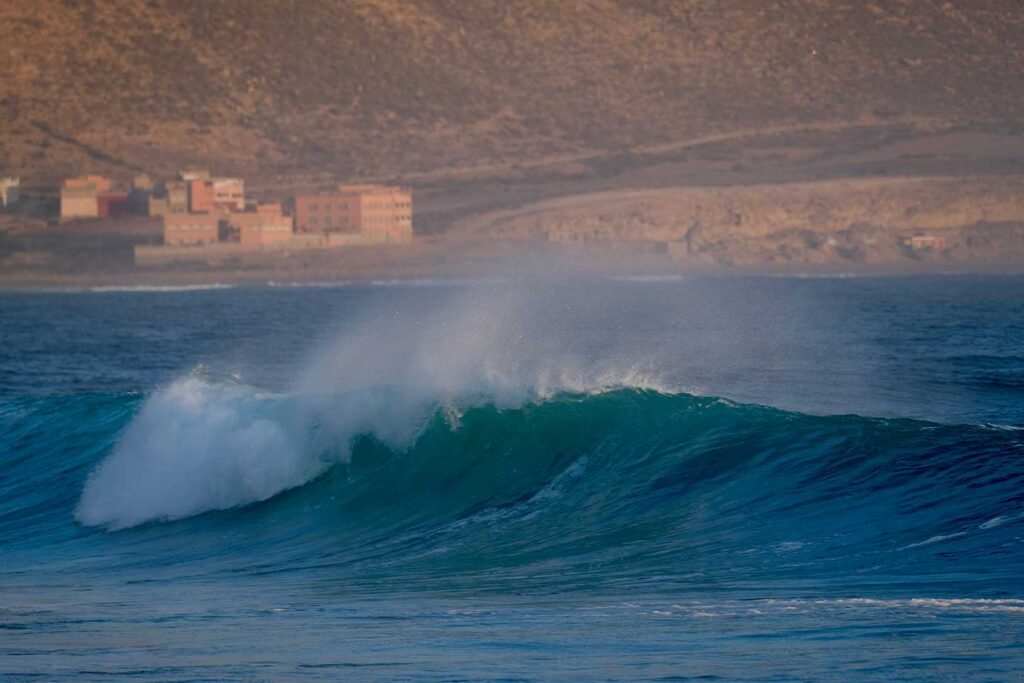
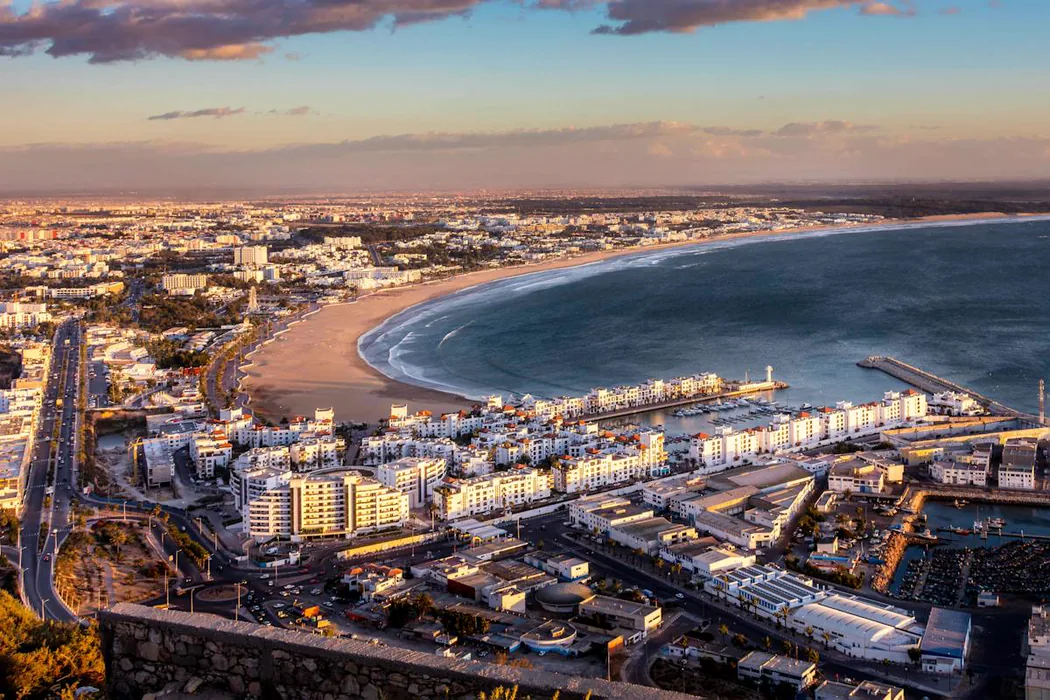
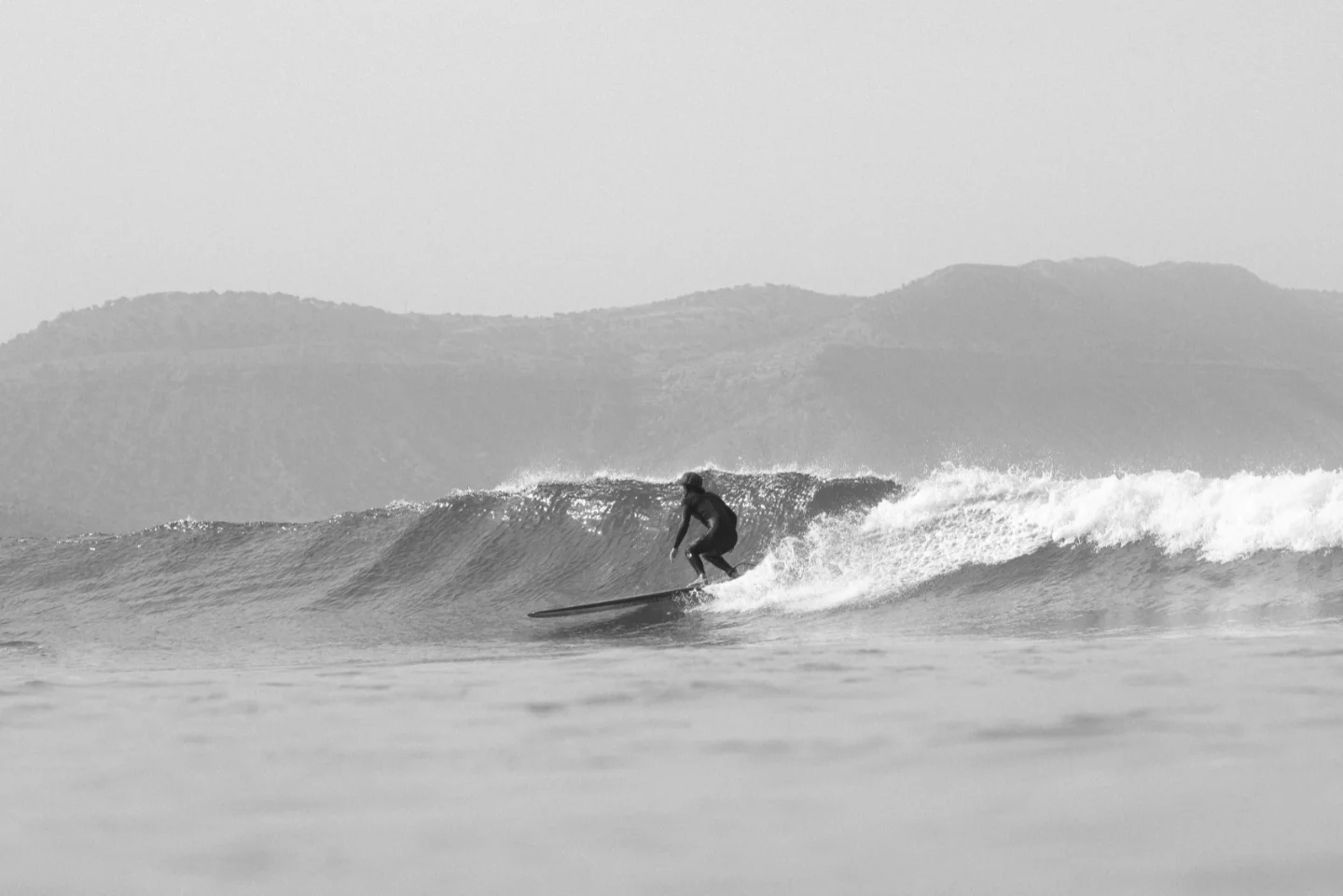
Imsouane Bay is a right-hand point break. That means the wave breaks peeling from the reader’s left to right when you look at it from the beach, and it does so in a clean, predictable line along a natural point of land rather than a shifting sandbar. The swell arrives from the open Atlantic, wraps around the headland that shelters the harbour, and starts to break as the water shallows toward the long crescent beach. By the time it reaches the take-off zone, it’s already shed most of its power against the headland — which is why the wave is gentle enough for beginners, and also why it can peel for the better part of a minute on a good day.
Independent surf guides describe the Bay with language like “arguably the best right-hand longboard wave in Morocco” and “hundreds of metres of riding” — and on the biggest, cleanest winter days, Surf Atlas’s Imsouane guide puts the description in the chest-to-overhead, long-period territory. Other sources go further and call it “one of the longest waves in the world.” That’s not marketing copy — it’s a genuine feature of the geography. A long-period Atlantic groundswell, N to NW in direction, meeting a rock-and-sand-bottom point with the right orientation, will do exactly what Imsouane Bay does.
The practical consequence is that the Bay behaves very differently from a beach break. Beach breaks shift, close out, punish mistakes with short fast takeoffs. Imsouane Bay gives you time. Time to find your feet after popping up. Time to trim and actually feel the board glide. Time to make the mistakes every beginner makes without being rinsed for them. If you’ve been surfing beach breaks in the UK or France and felt like you were drinking from a fire hose, the Bay is the opposite — it gives you the same wave, over and over, until you stop being bad at it.
That said, Imsouane Bay isn’t a featureless conveyor. On bigger days the wave becomes what surfers call “sectiony” — it peels cleanly for a stretch, closes out briefly, then reforms further down the line. You learn to read this after a few sessions. On smaller days it’s mellower and more continuous. Locals check the forecast on Surfline’s Imsouane report and plan their mornings accordingly — and so do we.
The Cathedral: Imsouane Bay’s faster, meaner cousin
When people say “Imsouane” they almost always mean the Bay. But there are two surf spots in the village. The other is La Cathédrale, and it’s the Bay’s tougher sibling.
The Cathedral sits on the opposite side of the headland from Imsouane Bay. Where the Bay is a slow, forgiving right-hand peeler, the Cathedral is faster, heavier, and less forgiving. Some sources describe it as a right-hand point break with additional beach peaks; others as a beach break ending in a point. The truth is it’s a reef-influenced spot with a rock-and-sand bottom and more exposure to raw NW and W Atlantic swells, which means it works bigger when the Bay is holding and it works harder on the surfer who rides it. In winter’s big swell windows, it turns into a tube spot. That’s an intermediate-and-up wave, not a learning wave.
The two spots are a useful pair. The Bay is mellow; the Cathedral is punchy. The Bay forgives mistakes; the Cathedral doesn’t. When the swell is too small for the Cathedral to show up, Imsouane Bay is still rolling. When the swell is too big for the Bay to be fun (it gets fast and sectiony), the Cathedral is firing. If you’re a week-long guest at a surf camp in Imsouane, you’ll likely surf both — starting at the Bay and moving to the Cathedral when your coach says your paddling and pop-up are ready.
One note on tides, because sources disagree: some guides call the Cathedral a low-tide spot, others call it a mid-to-high-tide spot, and the honest answer is the tide window is narrower than the Bay’s and it depends on the specific swell direction on the day. Local knowledge wins. Go with whoever in the water has grey hair and a longboard.
The Imsouane Bay lineup: where to sit, when to paddle, how not to be hated
Imsouane Bay has a crowd problem, and being honest about it is more useful than pretending it doesn’t. On a good winter day the takeoff zone can hold 40–50 surfers. On a Reddit thread about Imsouane the most upvoted comment is: “Imsouane, Taghazout and all its overcrowded af, especially when it’s small so you have the beginners at the same place as intermediates.” That’s accurate. Here’s how you behave so you’re part of the solution, not the problem.
Understand the priority system. The surfer closest to the peak — the person deepest on the wave, nearest to where it’s first breaking — has priority. If they paddle and go, no one else on that wave goes. Dropping in on someone with priority is the single worst thing you can do in a lineup. It’s also the most common beginner mistake. If you see someone up-and-riding on your side of the wave, you do not go. You pull back. You paddle around their shoulder, let them pass, and take the next one.
Sit on the inside as a beginner. If you’re new to Imsouane Bay, don’t paddle out to the main peak with the longboarders and locals. Sit further down the line, inside, where the wave has already rolled past the takeoff zone and is reforming. You’ll get plenty of rides, they’ll be shorter and less crowded, and nobody will resent you for being there. As you get better, you move up. Not before.
Paddle back via the channel, not through the lineup. Once you’ve ridden a wave to the end, paddle back wide — around the outside of the break — rather than paddling straight back through the takeoff zone. Crossing the lineup makes you a moving obstacle. On bigger days at the Bay many surfers choose to walk back along the harbour breakwater rather than paddle, especially on longboards — which is both faster and kinder to the lineup.
Don’t shout. The only people who shout in the water at Imsouane are surfers who don’t know what they’re doing. Communication in a crowded lineup is by eye contact and quiet calls. “Go!” means go. “Hold!” means hold. Everything else, read the situation.
Know that the locals have been here longer than you. Some of the regulars at Imsouane Bay have surfed here for 25 years. They don’t shout. They sigh. If an older surfer sighs at you, you did something wrong — usually a drop-in — and the sigh is the only feedback you’re getting. Don’t do it again.
Seasons at Imsouane Bay: when the wave is actually best
Imsouane Bay surfs year-round but the character of the wave changes significantly across the seasons. A practical breakdown:
Winter (November–March). Peak season. Biggest, cleanest, most consistent swell — long-period Atlantic groundswells lined up from the N and NW, offshore trade winds calmer than in summer, the Bay firing chest-to-overhead on the big days. Water temperature sits around 17–18°C, which is cool enough that you’ll want a 4/3mm wetsuit. This is when every serious surfer in Europe is booking Morocco. It’s also when the lineup is at its most crowded and the village at its busiest. If you want the best waves of the year and are happy to share them, winter is the answer.
Spring (March–May). Smaller, mellower, warmer. Water climbs to 18–20°C and a 3/2mm wetsuit is enough. Crowds thin significantly. The swell still arrives but the intervals are shorter and the waves are less powerful. For a beginner or early-intermediate, spring is arguably the best learning window of the year at Imsouane Bay — you get clean, forgiving waves without fighting the peak-season crowd.
Summer (June–August). The smallest surf of the year. Waves often drop to 0.5–1m, the wind swings onshore in the afternoons, and the Cathedral largely shuts down. The Bay, being sheltered, still produces rideable waves — but they’re longboard waves, not shortboard waves. Water is warm enough (20–22°C) for a shorty or boardshorts. If your priority is your first-ever surf trip, not chasing size, summer has its own case: cheap, quiet, hot, and the wave is almost too easy.
Autumn (September–November). The underrated season. Atlantic swell starts building again, water is still warm at 19–21°C (a 3/2mm wetsuit), crowds are moderate. You get real waves without the winter pressure. Camps are less full. If you can time a trip here, do it.
For the full month-by-month breakdown across the whole Moroccan coast, our best time to surf in Morocco post is the companion piece.
Longboard vs shortboard at Imsouane Bay
Imsouane Bay is, above all else, a longboarder’s wave. The slow peel, the long ride, the mellow takeoff — these are exactly the conditions a longboard is built for. On a 9-footer you’ll glide down the line and trim for 20–30 seconds in a way that’s almost impossible on any other wave in Morocco. If you’ve ever wanted to learn to longboard, or to work on your cross-stepping and noseriding, this is one of the best places in the world to do it.
Shortboards work too, but with an important caveat. The wave often has flat sections between pockets — the sectiony bits mentioned earlier — which kill a shortboard’s speed. Short, thin, high-rocker boards don’t glide through flat spots; they stall. The result is shortboarders at Imsouane Bay spend more time paddling between rides and less time on the face of the wave than longboarders do.
The best compromise is a mid-length. A 7’0″ to 7’10” hybrid or a performance mid-length gives you enough volume to glide through the flat sections, enough rocker to turn when the wave shows a real face, and enough responsiveness to still feel like you’re surfing rather than cruising. Most surf camps in Imsouane, ours included, carry a mix of foamies (8’–9′ for total beginners), hybrids (6’6″–7’6″ for intermediates), and a few longboards in the 8’6″–9’6″ range. If you’re bringing your own board and you only ride shortboards, seriously consider bringing a second board — a mid-length or a small longboard — just for the Bay.
For a deeper look at why this is specifically a longboard destination, our Imsouane longboard post covers the board-choice question in more detail.
Getting to Imsouane Bay
Imsouane isn’t a transport hub. You fly into Agadir Al Massira airport (AGA), the main arrival point for the whole Moroccan Atlantic coast, and then you drive north for roughly two hours along the coast road. There’s no train. There’s no airport shuttle. You have three options.
Private transfer. The most common choice. Most surf camps include it in the package, or you can book independently — typical pricing runs €60–€100 for a private car, door-to-door, luggage included. Your camp will arrange it if you ask. This is the path of least resistance and what we recommend if you’re arriving jet-lagged at 11pm.
Grand taxi (shared). Considerably cheaper. You share with other passengers and the driver leaves when the car is full. You go to the taxi rank outside Agadir airport or in the city centre, negotiate a price to Imsouane (expect to pay less than a private transfer), and go when full. Works better if you speak some French or Arabic, travel light, and are not on a schedule.
Rental car. If you want to explore other spots or venture down to Taghazout mid-week, a rental car is worth it. The drive is scenic — you pass through argan forests and hit a final switchback before Imsouane Bay reveals itself below. Drive in daylight if you can; the coastal road has blind bends and livestock on the verge.
Whichever route you choose, our booking page lists the transfer options we arrange for guests.
The 2024 demolitions: what changed
If you’ve read about Imsouane online, you may have come across the story of the demolitions. In early 2024 Moroccan authorities cleared a number of restaurants, surf shops, and small businesses along the waterfront, citing that they had been built without permits on land that was not privately owned. The news reached the international surf press and a lot of people in the surf community were upset about it. That’s real.
Here’s what it means in practice today. Several of the old beachfront spots are gone. The village has a different, quieter look than it did five years ago. Most of the camps and guesthouses further up the hill — including ours — were not affected, because they’re not on the demolished strip. The wave itself, obviously, is unaffected. Imsouane Bay is a natural feature of the headland and the harbour. It’s still there, it’s still the longest right-hander in Africa, and it’s still doing what it’s been doing for a thousand years.
We think the demolitions are a fair reason to expect the village to change slowly over the next few years, and probably a reason to come now if you’ve been putting it off. Whatever your view on the politics of the thing, the surf hasn’t moved.
Where to stay within paddling distance of Imsouane Bay
The basic rule is: the closer to the water, the better. Walking your board down to the beach, surfing, then walking back up for lunch is the rhythm that makes an Imsouane trip feel like an Imsouane trip. Camps and guesthouses spread up the hillside above Imsouane Bay; most of the ones worth staying at are a 5–10 minute walk from the sand.
For our full take on what it’s actually like staying here — the rooftop, the food, the rhythm — our Olas Surf Camp in Imsouane post covers the experience in detail. The short version: look for a place you can walk down from in a wetsuit, with a rooftop for the evening mint tea, and a forecast huddle at breakfast that tells you which of the two spots is working today.
How Olas works with Imsouane Bay
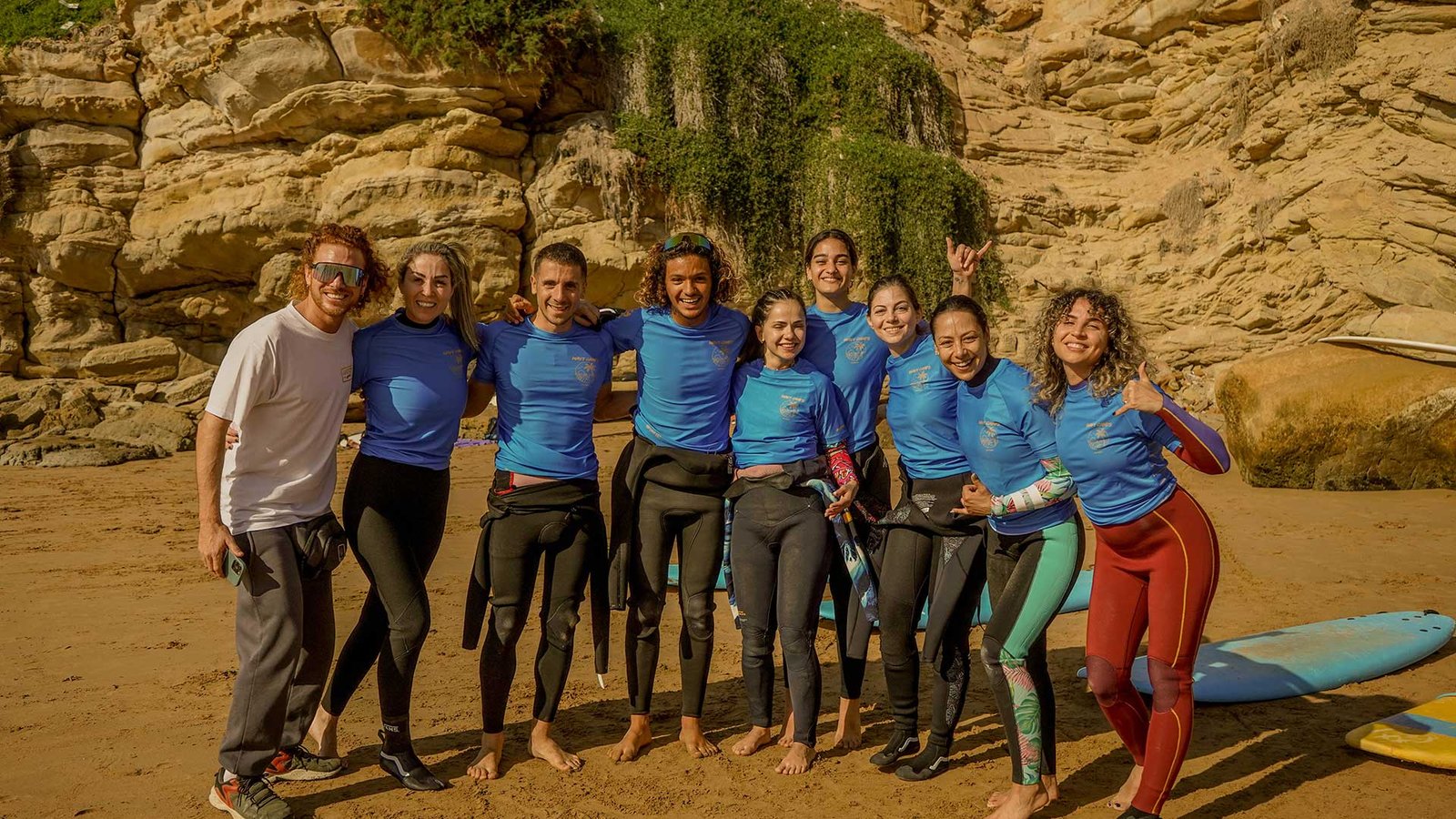
We’re a short walk above Imsouane Bay. Every morning at 9:30am the head coach reads the forecast — swell height, period, direction, wind forecast, tide times — and decides whether we walk down to the Bay or drive the vans round to the Cathedral. Most days we do both: a morning session at whichever is better, lunch, then a second session in the afternoon at whichever has come on.
Beginners almost always surf the Bay first. Intermediates and up rotate between the two depending on size and conditions. We adjust groups through the week — if a guest booked as an intermediate is clearly ready for the Cathedral by Wednesday, they move. If a winter swell is too big for the Cathedral, we stay at the Bay and work on longboard technique. The split between the two waves is the main reason Imsouane is such a good week-long destination: there’s always something working for your level.
If you want the full package — accommodation, food, boards, wetsuits, coaches, transfers — our surf camp page has the logistics, and our booking page has availability.
FAQ
Is Imsouane Bay good for beginner surfers?
Yes, and it’s one of the best beginner destinations in the world. Imsouane Bay is a slow, long, forgiving right-hand point break with a sand-and-rock bottom — a learning wave by any definition. Ride lengths of 20–30 seconds are common for beginners on foam boards, compared to the 2–5 second whitewater rides most beginners get at beach breaks back home. The Cathedral is harder and not a beginner wave, but you don’t need to surf it — most camps keep beginners at the Bay all week.
How long is the wave at Imsouane Bay?
On a good day, rides at Imsouane Bay can stretch for hundreds of metres. Independent surf guides describe it as “one of the longest waves in the world” and put ride lengths in the 200m-plus range on clean, long-period swell. On smaller days the rideable line is shorter, and on the biggest days the wave becomes sectiony — still rideable, but in shorter peeling pockets rather than one continuous face.
What wetsuit thickness do I need for Imsouane Bay?
Water temperature sits around 17–18°C in winter (a 4/3mm full wetsuit is the right call), 18–20°C in spring (3/2mm), 20–22°C in summer (a shorty or boardshorts for the warm-blooded), and 19–21°C in autumn (3/2mm). If you only own one wetsuit and want to use it across the full year, a 3/2mm plus a thermal rash vest will get you through all seasons except the coldest winter weeks.
When is the best time of year to surf Imsouane Bay?
For experienced surfers chasing size, winter (November to March) is peak season — biggest swell, most consistent. For beginners and intermediates who want the best balance of clean waves and manageable crowds, spring (March to May) and autumn (September to November) are the sweet spots. Summer is the quietest and smallest but is the most accessible if you’ve never surfed before and want warm water and no pressure.
Is Imsouane Bay always crowded?
In peak winter weeks and on classic days, yes — Imsouane Bay is known for its crowds, and the reality is that on a clean 1.5m day you’re sharing the peak with 40+ surfers. Outside peak weeks, weekdays, early mornings, and spring/autumn shoulder weeks can be notably quieter. The size of the crowd is also why lineup etiquette matters so much — a crowded day with good etiquette is still a great day; a crowded day with bad etiquette ruins everyone’s session.
Do I need a car to surf at Imsouane Bay?
No. The village is small and walkable, Imsouane Bay is a 5–10 minute walk from almost any camp, and the Cathedral is a short drive that camps handle with their own vans. A car is useful only if you want to venture south to Taghazout, Tamraght, or Agadir for a day. If you’re staying put in Imsouane for a week, skip the rental and use the transfer money for a massage.
What’s the difference between Imsouane Bay and the Cathedral?
Imsouane Bay is a slow, mellow right-hand point break ideal for beginners and longboarders; the Cathedral, on the other side of the headland, is a faster, heavier wave with reef influence that suits intermediate and advanced surfers. The Bay works in almost all conditions; the Cathedral needs a cleaner, bigger swell. Most surf camps in Imsouane teach at the Bay and run sessions at the Cathedral when guests are ready.
The short version
Imsouane Bay is the reason you come to Imsouane. It’s one of the longest right-hand point breaks on Earth, gentle enough for beginners, long enough for longboarders to cross-step until their legs hurt, and paired with the harder Cathedral so intermediates have somewhere to progress to. It has a crowd problem and a priority system, and learning to behave in the lineup is half of what makes a trip here worthwhile. The village has changed since the 2024 demolitions but the wave hasn’t. Come in autumn or spring if you can; come in winter if you want the biggest days and don’t mind sharing. Book a camp that’s a short walk from the sand.
If you want to talk through which season and which setup suits you best, our booking page is the way in.

0 Comments