
Imsouane weather is the main reason this fishing village at the back of a headland on Morocco’s Atlantic coast draws surfers from Northern Europe every winter. The short version: roughly 300 days of sunshine a year, air temperatures that rarely dip below 13°C or climb past 28°C, water temperatures that move between 17°C in January and 23°C in August, and swell that arrives far more often than it doesn’t. This guide breaks the numbers down month by month, with honest notes from a surf camp that tracks the forecast every morning.
Imsouane weather, month by month
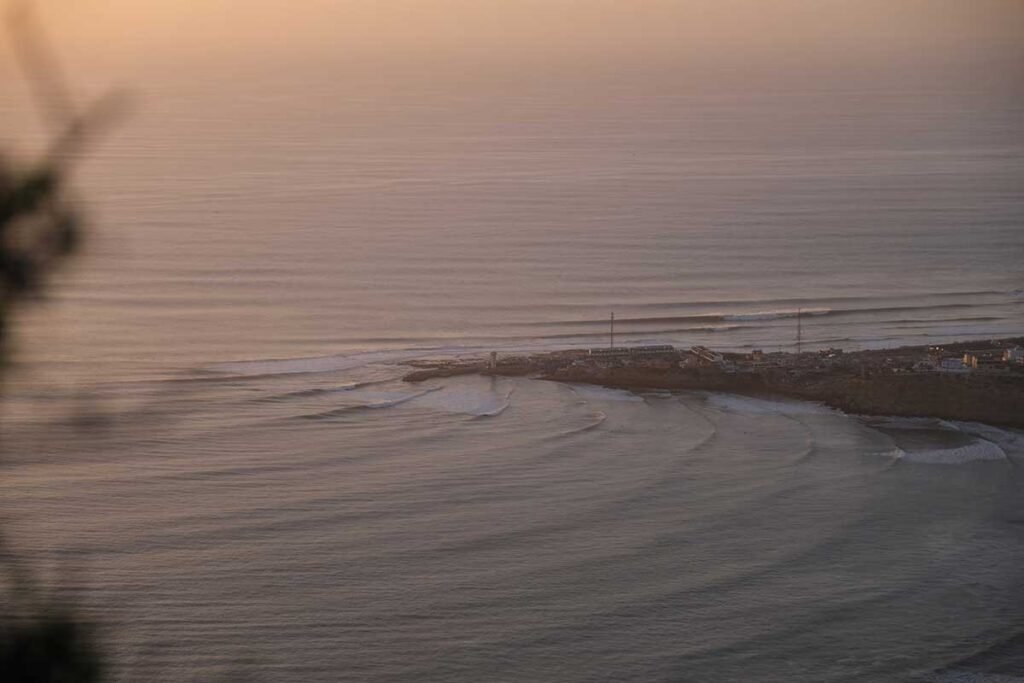
Imsouane sits at 30°50’N, on a horseshoe bay sheltered from the worst of the onshore wind by a 150-metre headland. The surrounding hills give it a mild micro-climate that stays more consistent than either Essaouira (windier, further north) or Agadir (warmer, further south). Here’s the month-by-month view:
| Month | Air high | Air low | Water temp | Sunny days | Rain days |
|---|---|---|---|---|---|
| January | 19°C | 10°C | 17°C | 22 | 4 |
| February | 20°C | 11°C | 17°C | 22 | 4 |
| March | 21°C | 12°C | 17°C | 25 | 3 |
| April | 22°C | 13°C | 18°C | 26 | 2 |
| May | 23°C | 15°C | 19°C | 28 | 1 |
| June | 24°C | 17°C | 20°C | 29 | 0 |
| July | 26°C | 19°C | 22°C | 30 | 0 |
| August | 27°C | 20°C | 23°C | 30 | 0 |
| September | 26°C | 19°C | 22°C | 28 | 1 |
| October | 24°C | 17°C | 21°C | 26 | 2 |
| November | 22°C | 14°C | 19°C | 24 | 3 |
| December | 20°C | 11°C | 18°C | 22 | 5 |
What the numbers don’t show: Imsouane weather is genuinely drier than its latitude would suggest. The village sits in the rain shadow of the Western High Atlas, so even when Essaouira is getting its seasonal gales, Imsouane is often clear. Winter storms do arrive — they’re what generates the swell — but they usually pass in 12–36 hours, and the morning after is almost always offshore and clean.
How many days of sunshine does Imsouane get?
Roughly 290–310 sunny days a year, depending on how strictly you count “sunny”. That’s in the same bracket as Dakhla (further south in the Western Sahara) and noticeably better than the Portuguese Algarve or the Spanish Costa de la Luz at comparable latitudes. Why? Because the Canary Current keeps marine cloud cover from developing over the coastline for most of the year, and the African interior’s dry air dominates the weather pattern from April through October. In practice, you’ll see an overcast morning maybe once every two or three weeks between May and September, and closer to once a week between November and March. The rest of the year is blue sky, low humidity, and long shadows on the beach by 5pm.
Imsouane weather and water temperature year-round
Water is what catches most first-timers off guard. The Moroccan Atlantic isn’t tropical — the cold Canary Current pulls water up from the deep and keeps sea temperatures 2–4°C cooler than the air for most of the year. At Imsouane that means:
- January–February: 16–17°C. A 4/3mm full wetsuit is sensible; the most cold-sensitive surfers add a 1mm hood for dawn sessions.
- March–April: 17–19°C. A 4/3mm is still the call.
- May–June: 19–21°C. 3/2mm for most; a springsuit works for the warm-blooded.
- July–September: 21–23°C. Springsuit weather. Boardshorts for the committed.
- October–November: 20–22°C. 3/2mm or springsuit.
- December: 17–19°C. Back into a 4/3mm.
Most surf camps, including us, supply the right wetsuit for the month you book, so you don’t need to pack one. The wider Morocco water-temperature picture is in our best time to surf in Morocco guide, which covers every month against the full Atlantic coastline rather than just our village.
Imsouane weather: wind patterns that make or break a session
The single biggest variable in a day’s surf quality isn’t swell size — it’s wind. Imsouane’s prevailing wind is NE to E, which blows offshore at the Bay (the wave faces roughly west-southwest). That’s why mornings here so often look glassy: the NE flows down off the headland and holds the wave face smooth. By early afternoon, as the land heats up, a sea breeze kicks in from the WNW and the surface chops up. Peak wind usually hits between 2pm and 5pm, then drops again before sunset.
Practical consequence: if you only surf one session a day at Imsouane, make it the 9am to 11am window. That’s when the wind is with you and the wave is doing its long-peel thing. Afternoon sessions are workable but choppier, and pure-shortboard surfers often skip them. For daily forecast detail, the Windy.com live wind map for Imsouane is the industry reference, and Surfline’s Imsouane report gives the combined swell-and-wind forecast that most local coaches cross-check each morning.
Rainfall and the rare bad-weather window
Total annual rainfall at Imsouane is around 250–300mm, most of it falling between November and March. In practice, this translates to 4–5 rainy days a month in winter and almost none in summer. When it rains, it rains hard and briefly — a 90-minute downpour that clears to blue sky by lunch is more common than all-day grey. The roads into the village are exposed in two places where heavy rain can cause brief flooding; if you’re driving in from Agadir on a stormy January afternoon, just delay the trip by a few hours. Nothing about it is dangerous. It’s a village that’s been shaped by the same weather pattern for a thousand years and it knows how to handle a storm.
What to pack for Imsouane weather
The packing list depends on the month, but these are the items nobody we’ve hosted has ever regretted bringing:
- A light fleece or sweater. Evenings drop to single digits from November to February. The terrace gets chilly by 8pm.
- Sunblock rated SPF 50+. You’re at 30°N with thin cloud cover; UV is stronger than most European visitors expect, year-round.
- A light rain jacket for December–February. Not a full hard-shell; something packable.
- A buff or light scarf for the afternoon sea-breeze hours — it’s not cold, just persistent.
- Flip-flops and one pair of closed shoes. The walk from camp to the Bay is on sand and rock; flip-flops work most days, closed shoes help when it’s wet.
- A 2-litre water bottle. The climate is dry and the surfing dehydrates you faster than you expect.
How Imsouane weather compares to nearby spots
Imsouane sits about halfway between Agadir (95km south) and Essaouira (80km north). The three spots have meaningfully different weather:
- Agadir: warmer year-round by 1–2°C (air) and 1°C (water), slightly more humid in summer, less consistent wind. Better for a beach-holiday-with-surf mix.
- Essaouira: windier on almost every day of the year — it’s a kite and windsurf town for a reason. Cooler water, more marine layer cloud, less reliable sun.
- Taghazout: 15 minutes north of Agadir, essentially Agadir’s weather with slightly better wave orientation. More consistent winter swell but noticeably busier in peak weeks. For the head-to-head, see our Imsouane vs Taghazout comparison.
If weather stability is your top priority, Imsouane usually wins among the three. If warmth is, Agadir or Taghazout. If you want wind for another sport, Essaouira.
Weather is one ingredient of the trip. For activities outside the surf, see our guide to things to do in Imsouane — including sandboarding at Timlaline for flat days. If you’re coming in summer, the gentle wave is perfect for longboarding. And if you’re considering staying longer, the village suits digital nomads year-round.
Imsouane weather: FAQ
What is the climate like in Imsouane?
Imsouane has a mild, semi-arid coastal climate. Summers are warm (highs 24–27°C), winters are mild (highs 19–22°C), rainfall is low (around 250–300mm annually, concentrated in November–March), and sunshine averages 290–310 days a year. The village’s sheltered bay and hilly hinterland protect it from the worst of the Atlantic gales that hit Essaouira further north.
When is the best weather in Imsouane?
May, June and September give the most stable combination of warm air, warm water, consistent sunshine and manageable wind. July and August are hotter and busier. October and November are reliably sunny but the water starts cooling. For surf specifically, December through March combines the best swell with cooler but still comfortable weather — a 4/3mm wetsuit handles it.
Does it rain much in Imsouane?
Not by European standards. Total annual rainfall is around 250–300mm, with almost all of it falling between November and March. A typical winter month has 3–5 rain days, and summer rain is rare enough to be notable. Rain tends to come in short heavy bursts that clear within a few hours rather than extended grey weeks.
Is Imsouane water cold for surfing?
Cool, not cold. Water temperatures range from 16–17°C at the January low to 22–23°C at the August high. A 3/2mm wetsuit covers eight months of the year. December through April want a 4/3mm; July through September allow a springsuit or boardshorts. Compared to Cornwall, Portugal or southern Spain at similar latitudes, Imsouane water is on the warmer end.
How many hours of sunshine does Imsouane get per day?
On average, 9–10 hours of sunshine per day from April through October, and 6–7 hours per day from November through March. Summer solstice gives 14 hours of daylight; winter solstice gives 10. Across the year, daily sunshine averages around 8 hours — which is why the 290–310 sunny days per year figure adds up.
When is Imsouane’s windiest month?
Typically May and August, when the thermal sea-breeze pattern is at its strongest and afternoons chop up quickly. Even then, mornings are almost always offshore at the Bay because the prevailing NE-E wind flows down off the headland. The calmest month overall is usually October.
If you’re picking a week, our best time to surf in Morocco guide pairs weather with swell to tell you which month actually suits what you’re trying to do. And if you’ve already decided on December specifically, the Imsouane in December deep-dive has the Christmas-week booking reality.
0 Comments