

By Olas Surf Team — 4 August 2026
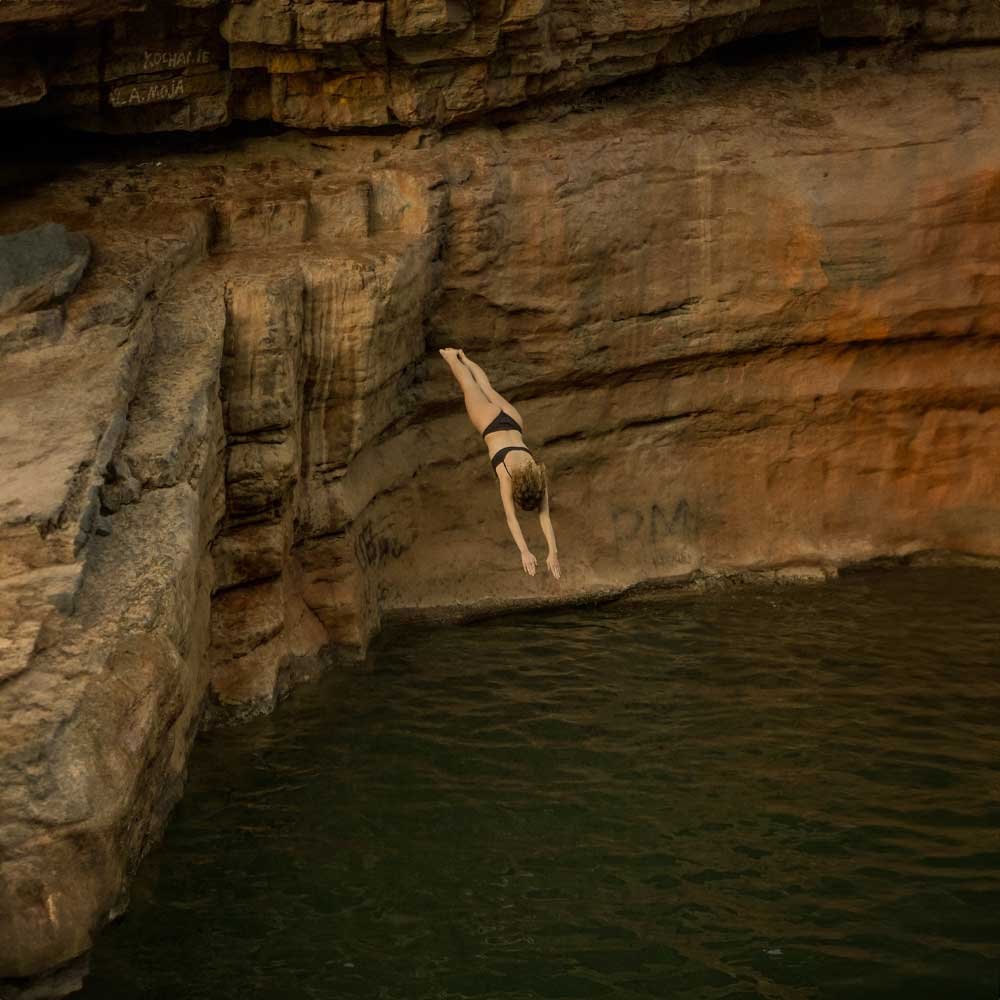
Paradise Valley Morocco is a palm-filled river gorge in the High Atlas foothills, about an hour inland from Agadir, where a series of freshwater pools sits between high rock walls. It’s the best day trip available from this stretch of coast and it is also comprehensively oversold. Whether you have a good day there depends almost entirely on the month you go, and nobody selling you a ticket is going to mention that.
We drive guests up there regularly. Here’s the version we give them before they decide.
What Paradise Valley Morocco actually is
The valley sits roughly 58 kilometres north-east of Agadir, up the road that climbs inland from Aourir — the town everyone calls Banana Village, for the roadside stalls selling small sweet local bananas. From there the road follows the Tamraght river up into the foothills, and the landscape shifts from dusty argan scrub to actual palms within about twenty minutes.
The valley itself is a limestone gorge. The river has cut a series of basins into the rock, some shallow, some deep enough to jump into from a height. Fig trees and oleander grow out of the walls. It’s genuinely beautiful and it looks nothing like the coast forty minutes away.
There’s no entry gate and no ticket. You park, you walk in, and depending on which section you’re heading for that walk is between ten minutes and an hour over uneven rock.
The part nobody tells you: water levels
This is the whole trip, and it’s the reason we wrote this.
Paradise Valley is fed by mountain springs and winter rain. The pools are not a permanent fixture at a constant level — they fill in winter and draw down through the summer. In a dry year, by August and September the upper pools can be shallow, stagnant, or gone.
Roughly what to expect:
- December to April — the pools are full and moving. Best water of the year. The water is also cold, which people forget.
- May and June — still good, warming up, and the landscape is green after the winter rain. This is the sweet spot.
- July and August — busiest and lowest. Still worth it if you go early and go further up the valley, but the accessible lower pools get crowded and warm.
- September to November — the low point in a dry year. Some seasons there’s very little water until the first proper rain arrives.
If you’re coming in late summer, ask before you commit a day to it. Any camp, riad or driver on this coast will know what the valley is doing that week, and most of us will tell you honestly, because a guest who comes back disappointed is worse for us than one who went sandboarding instead.
Getting to Paradise Valley Morocco from Imsouane
From Imsouane it’s roughly two hours each way. From Agadir or Taghazout it’s closer to an hour. That difference matters a lot for how the day feels.
By organised trip. Most camps and agencies on the coast run it, ours included via our extra activities. You’re looking at roughly 200–400 MAD per person from the Agadir side, more from Imsouane because of the distance. Transport and a driver are included; a guide usually isn’t necessary.
By grand taxi. Shared taxis from Agadir toward Aourir and up the valley run about 50–80 MAD per person, and a private taxi for the day is roughly 400–600 MAD split between however many of you there are. From Imsouane you’d first need to get down the coast, which makes this awkward.
Self-drive. The easiest option if you have a car. The road is paved the whole way and fine in a normal hire car, though it narrows and twists in the last stretch. Our guide to driving in Morocco covers the checkpoints and rules if you’re not used to it.
Whichever way you go, leave early. The lower pools fill with people from late morning, and in summer the difference between arriving at nine and arriving at noon is the difference between two trips.
What the day looks like hour by hour
Leaving Imsouane around eight, you’re at Aourir by half nine, stopping for coffee and a look at the banana stalls. Up the valley road by ten, parked by half ten.
The walk in from the main parking area to the first pools takes about fifteen minutes over rock. It’s not a hike, but it’s not a path either — proper shoes matter more than people expect, and flip-flops are a genuinely bad idea. Every year somebody goes over on wet limestone.
Most people spend two to three hours in the valley: swimming, sitting on rocks, working up the nerve to jump. There are small cafés near the main pools serving tagine and drinks, which are fine and priced for tourists.
The jumps are the thing everyone photographs. They range from a couple of metres to considerably more, and the deep pools are genuinely deep. But the depth changes with the season, which is exactly why jumping in September is a worse idea than jumping in March. Watch someone local go first, always.
Back at the car by two or three, home to Imsouane by five. It’s a full day and you’ll be tired.
Is Paradise Valley Morocco worth it?
Between December and June, yes, without hesitation. It’s a completely different landscape an easy drive from the coast, the water is real, and it breaks up a week of surfing with something that isn’t surfing.
In September after a dry summer, honestly, often not — at least not as a full day from Imsouane with four hours in a car. If you’re already in Agadir or Taghazout it’s a shorter commitment and easier to justify.
The alternative we usually suggest for a flat day is the Timlaline dunes, twenty-five minutes away rather than two hours, and entirely weather-proof. If you’d rather stay in the village entirely, there’s plenty in our guide to things to do in Imsouane, and if you’re routing through the airport city there’s a day’s worth in Agadir too.
The valley is somebody’s home, not an attraction
Worth holding in mind while you’re there. The Tamraght valley has villages in it, and the families living along the road were farming these terraces long before anyone drove up from the coast with a towel. The palms are cultivated. The water is irrigation as well as scenery.
In practice that means a few small courtesies go a long way. Ask before photographing people, particularly women. Buy something at the cafés rather than bringing everything and leaving nothing. If someone offers to watch your car for a few dirhams, that’s a job, not a scam — the same parking-guardian system you’ll meet in every Moroccan town.
The other reason to care is self-interested. Paradise Valley Morocco has had a litter problem for years, entirely driven by day visitors, and there’s been periodic local pressure to restrict access because of it. The valley stays open and free largely because most people behave. Take out what you carried in, including the fruit peel.
Practical notes
- Bring cash. No cards anywhere in the valley. Small notes for the cafés and parking.
- Shoes with grip. Wet limestone is slippery and the walk in is over rock.
- The water is cold year-round. It’s spring-fed, not sun-warmed.
- Modest swimwear is the norm. It’s a local family spot as much as a tourist one, and Moroccan women generally swim covered. Nobody will confront you about a bikini, but you’ll be more comfortable not being the only one.
- Take your rubbish out. The valley has a litter problem in high season, which is entirely a visitor problem.
- No shade at midday in the open sections. Hat, water, sunscreen.
If you want a general sense of the region before committing, Lonely Planet’s Agadir pages cover the wider area, and recent traveller reviews on Tripadvisor are the fastest way to see what the water is doing right now — sort by newest, not by rating.
We fold the valley into camp weeks when the season and the swell forecast make it the right call, usually on a flat day between December and June. If you’d like it built into your week, mention it when you book and we’ll tell you honestly whether your dates are good ones — the same way we did in our full account of a week here.
Frequently asked questions
How far is Paradise Valley from Imsouane?
Roughly two hours each way by road, which makes it a full day out. From Agadir or Taghazout it’s about an hour, so if you’re based further south it’s a much lighter commitment. The road is paved throughout and fine in a standard hire car.
When is the best time to visit Paradise Valley in Morocco?
December to June, with May and June the sweet spot — the pools are full from winter rain, the landscape is green, and the water has warmed slightly. Late summer and autumn are the weakest window because the pools draw down and, in a dry year, the upper ones can be very shallow.
Can the pools at Paradise Valley be dry?
Yes. The valley is spring and rain-fed, so levels drop through summer. By August and September in a dry year the upper pools can be shallow or empty. Always ask locally what the water is doing before committing a whole day, especially if you’re travelling from further up the coast.
How much does a trip to Paradise Valley cost?
An organised trip runs roughly 200–400 MAD per person from the Agadir side and more from Imsouane because of the distance. A shared grand taxi is around 50–80 MAD per person; a private taxi for the day is roughly 400–600 MAD split between the group. There’s no entry fee to the valley itself.
Is Paradise Valley suitable for children?
The lower pools are, with supervision. The walk in is over uneven rock rather than a path, the water is cold and some pools are deep, and the cliff jumps are absolutely not for children. Families generally do well staying at the first accessible pools rather than pushing further up the valley.
Do you need a guide for Paradise Valley?
No. There’s no entry gate and the main pools are easy to find from the parking area. A driver is worth having so you’re not navigating the mountain road yourself, but a guide adds little unless you want to walk well beyond the popular sections.
What should I bring to Paradise Valley?
Shoes with grip for the wet limestone, cash in small notes since nothing takes cards, sun protection because the open sections have no shade at midday, and a towel. Modest swimwear is the local norm and you’ll feel more comfortable in it.
Is Paradise Valley crowded?
The lower pools get busy from late morning in summer and during Moroccan holidays, when it’s a popular local family spot. Arriving early — before ten — or walking further up the valley both make a large difference. Between December and April it’s quiet.

0 Comments