

By Olas Surf Team — 4 August 2026
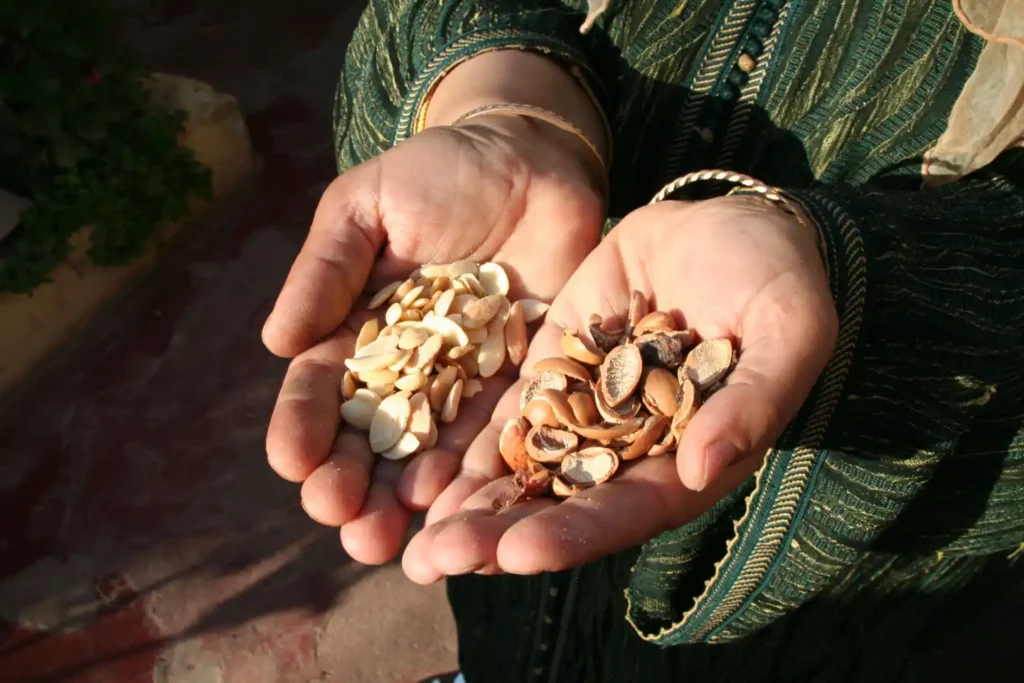
Argan oil Morocco produces comes from a tree that grows wild in essentially one place on earth: a wedge of south-west Morocco between Essaouira and the Anti-Atlas, with Imsouane sitting right in the middle of it. Every bottle sold anywhere in the world traces back to this landscape. UNESCO designated the whole area the Arganeraie Biosphere Reserve in 1998, which is a formal way of saying the forest is both irreplaceable and under pressure.
Most visitors buy a bottle of argan oil Morocco made without knowing any of that, and a good number buy something that isn’t really argan oil at all. Here’s what’s going on in the trees you drive past.
What argan oil Morocco actually is, and why it costs what it costs
The argan tree is a gnarled, thorny, drought-tolerant thing that lives for up to two hundred years and looks half-dead for most of them. It fruits once a year. Inside each fruit is a nut, and inside that nut are one to three small kernels. Those kernels are the entire product.
Getting to them is the whole story. The fruit pulp is removed and dried. The nut — genuinely one of the hardest in the natural world — is then cracked by hand, between two stones, one at a time. No machine has ever reliably done this without crushing the kernel inside, which is why in 2026 it is still done by women sitting on the floor with a rock.
It takes somewhere around twenty hours of work to produce a single litre. Roughly 30 kilos of fruit yields about one litre of oil. When you see the price on a bottle, that’s what you’re looking at — not a marketing markup but an enormous amount of human labour that nobody has managed to mechanise.
The argan oil Morocco sells comes in two forms. Cosmetic argan oil is pressed from raw kernels: pale, mild, and what goes on skin and hair. Culinary argan oil is pressed from kernels roasted first: darker, distinctly nutty, and used on bread, in couscous, and as the base of amlou.
If a shop offers you one bottle for both purposes, they’re either simplifying or selling you something adulterated. They’re different products.
The goats. Yes, they’re real. Mostly.
Goats really do climb argan trees. It isn’t a trick and it isn’t recent — goats have been going up after the fruit for as long as there have been goats and argan trees together, and the animals are genuinely good at it, balancing on branches thinner than you’d credit.
So the phenomenon is real. What’s often not real is the specific tree you’re being invited to photograph.
On the tourist stretch of the coast road, particularly between Agadir and Essaouira, there are trees where goats have been placed by hand and are kept there through the day, with a man nearby who will ask for money when you stop. The goats are tethered or simply too high to get down on their own. In peak season some of these animals stand in a tree in full sun for hours.
How to tell the difference:
- Time of day. Real foraging happens early morning and late afternoon. A tree full of goats at one in the afternoon in August is a set-up.
- The lay-by. If there’s a conveniently wide shoulder, a man waving you down, and a tree right at the roadside, that’s a business.
- Behaviour. Foraging goats move, browse and come down. Staged goats stand still.
- Numbers. Six goats artfully spread across one small tree is not how goats distribute themselves.
Genuine ones are easy enough to see if you’re paying attention — on the inland roads, on the hills behind the coast, away from anywhere designed for stopping. Don’t pay for the staged version and it stops being worth doing.
Argan oil Morocco cooperatives: which are worth your time
Since the 1990s much of the argan oil Morocco exports has been produced through women’s cooperatives, a model that started partly as a rural development project and has become one of the more genuinely successful things of its kind in the country. For many women in the Souss it’s the first independent income they’ve had.
The model works — but “cooperative” is not a protected word, and plenty of roadside shops use the sign without the structure behind it.
What a real one looks like:
- Women actually working on site, cracking nuts, not performing for a tour bus.
- They’ll let you watch and ask questions without hurrying you toward the till.
- Prices are posted and consistent, not negotiated per customer.
- Bottles carry a label with the cooperative’s name and a production date.
- They’ll happily explain the difference between cosmetic and culinary, and let you smell both.
Warning signs: a huge car park and a tiny production room, a “guide” who steered you there and lingers, no visible work happening, and pricing that changes when they hear your accent.
There’s a run of legitimate cooperatives on the road between Agadir and Essaouira and several in the hills inland from Tamraght. If you’re driving that stretch anyway, our guide to driving in Morocco covers the road itself, and there’s a natural stop or two on the route between Agadir and Imsouane.
How to tell real argan oil Morocco from the cut stuff
Adulteration is common — usually cheap sunflower or olive oil with a little argan in it, sometimes no argan at all.
Smell. Cosmetic argan has a faint, slightly nutty smell that fades within minutes of going on skin. Culinary argan smells strongly and unmistakably of roasted nuts. Something that smells of nothing, or smells perfumed, is not what you want.
Feel. Real cosmetic argan absorbs. If it sits on your skin like a slick after five minutes, it’s been cut with something heavier.
Colour. Cosmetic should be pale gold. Culinary is noticeably darker and browner. Anything bright yellow or completely clear is suspect.
Container. Argan oil degrades in light. Good oil comes in dark glass. A clear plastic bottle on a sunny roadside shelf tells you what you need to know about how it’s been stored, whatever’s in it.
Price. Given the labour involved, oil that seems remarkably cheap is remarkably cheap for a reason. There’s no bargain version of twenty hours of work.
The Moroccan government operates a protected designation of origin for argan oil, and reputable cooperatives will reference it. UNESCO’s page on the Arganeraie Biosphere Reserve is worth a look for the conservation context, and National Geographic has covered the industry’s economics in more depth than we can here.
Amlou, and why the culinary argan oil Morocco makes is the one to take home
If you take one thing home, consider making it the roasted culinary oil rather than the cosmetic. It’s the version most visitors skip and the one you can’t easily replace at home.
Amlou is what it’s for: culinary argan oil blended with roasted almonds and honey into a thick paste, somewhere between a nut butter and a spread. It appears at breakfast across this region, spooned onto bread still warm from the village oven. Guests at the camp encounter it on their first morning and a fair number ask where to buy some before the week is out.
You’ll also find culinary argan drizzled over couscous, stirred into tagine at the end, and served in a shallow dish with bread as a first thing on the table. It’s the taste of this specific corner of Morocco in a way that mint tea, which is national, isn’t.
Seeing the forest from Imsouane
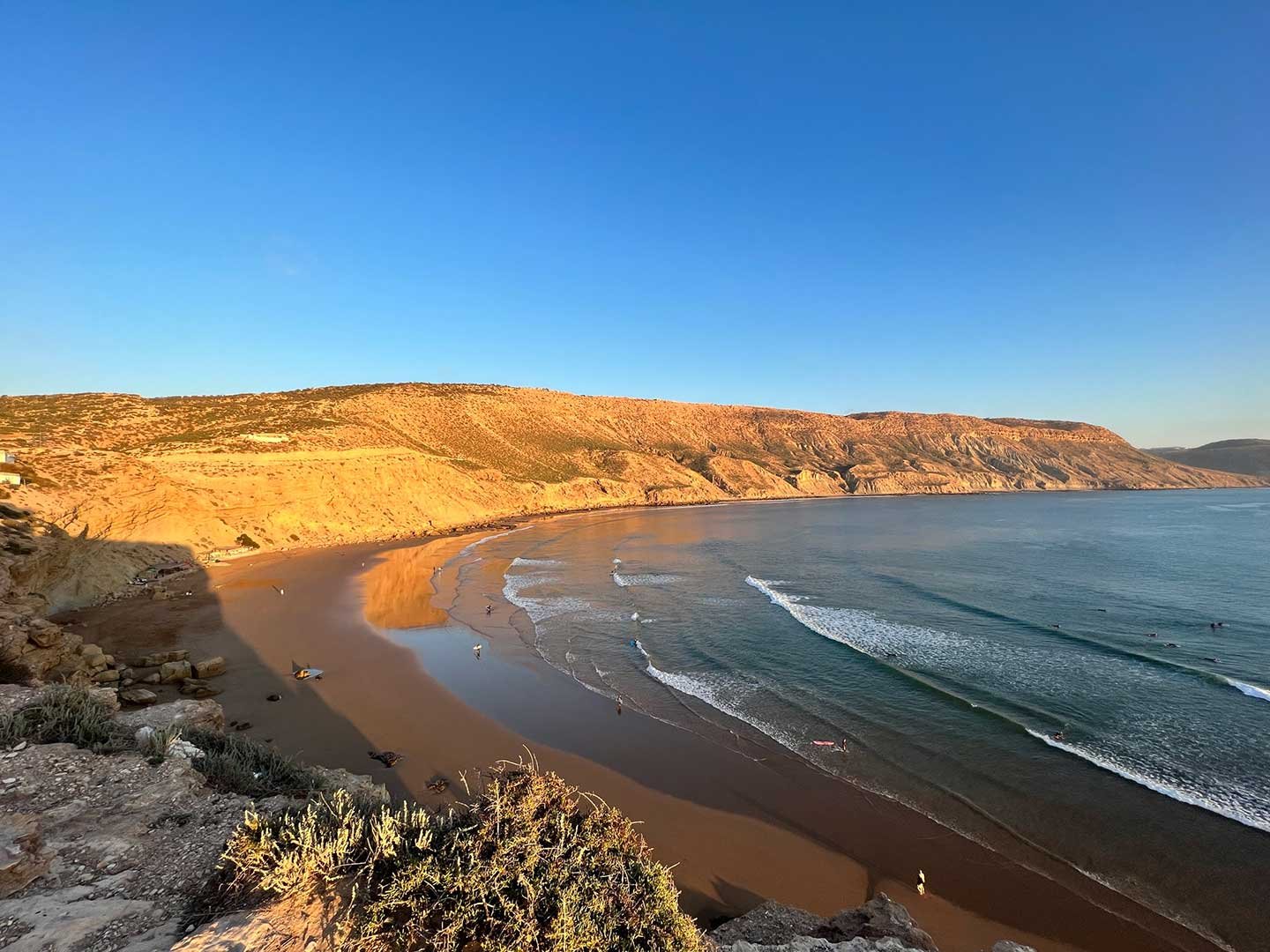
You don’t need an excursion. The argan forest starts immediately behind the village and the hills above the bay are full of trees, goats and small terraced plots. Walking up the cliff path and inland for half an hour puts you in it, and after winter rain the whole landscape goes green — a version of it most visitors never see, since the majority come in summer when it’s uniformly brown.
Several of our guests end up doing this by accident on a flat day, and it’s included in the wider list of things to do around the village. If you’d like it as a proper trip with a stop at a cooperative, it’s one of the options under extra activities — and if you’re building a week around this coast, tell us when you book and we’ll work out whether the season suits it. There’s more on how the days actually shape up in our honest account of a week here.
Frequently asked questions
Where does argan oil come from in Morocco?
From a wedge of south-west Morocco between Essaouira and the Anti-Atlas, taking in Agadir, Imsouane and the Souss valley. The argan tree grows wild essentially nowhere else on earth, and UNESCO designated the area the Arganeraie Biosphere Reserve in 1998.
Why is argan oil so expensive?
Because the nut has to be cracked by hand between two stones — no machine does it reliably without destroying the kernel. It takes roughly twenty hours of labour and about 30 kilos of fruit to produce one litre. The price reflects work, not markup.
Do goats really climb argan trees?
Yes, genuinely, and they always have — they go up after the fruit and are remarkably good at balancing on thin branches. But some roadside trees on the tourist stretch have goats placed in them by hand and kept there for photographs. Real foraging happens early morning and late afternoon, not at midday.
How can you tell if argan oil is real?
Cosmetic argan is pale gold, absorbs into skin within minutes and smells faintly nutty. Culinary argan is darker and smells strongly of roasted nuts. Real oil comes in dark glass because it degrades in light. Anything odourless, perfumed, greasy after five minutes or suspiciously cheap has probably been cut with sunflower or olive oil.
What is the difference between cosmetic and culinary argan oil?
Cosmetic oil is pressed from raw kernels and is pale and mild, for skin and hair. Culinary oil is pressed from kernels roasted first, making it darker and distinctly nutty, and is used on bread, over couscous and as the base of amlou. They’re different products — a shop selling one bottle for both uses is cutting corners.
Are argan oil cooperatives worth visiting?
The genuine ones are. Look for women actually working on site, posted prices that don’t change per customer, labelled bottles with production dates, and staff happy to explain the process without steering you to the till. Be wary of large car parks with tiny production rooms and guides who linger after bringing you.
What is amlou?
A thick paste of culinary argan oil, roasted almonds and honey, somewhere between nut butter and a spread. It’s a breakfast staple across south-west Morocco, eaten on fresh bread, and it’s the single best reason to buy the roasted culinary oil rather than the cosmetic one.
Can you see argan trees near Imsouane?
Easily — the forest starts immediately behind the village and the hills above the bay are full of trees, goats and small terraced plots. Half an hour up the cliff path and inland puts you in it. After winter rain the whole landscape turns green, which most summer visitors never see.





0 Comments