

By Olas Surf Team — 4 August 2026
A Moroccan hammam is a public steam bath, and going to one is the thing our guests ask about most nervously and rave about most afterwards. The nervousness is entirely about not knowing the choreography — what you wear, who does what to whom, whether you’re supposed to bring something. So here’s the choreography, step by step.
None of this is exotic to Moroccans. Most people here go weekly. It’s closer to a trip to the local pool than to a spa treatment, and that framing helps.
Public or tourist: two very different experiences
The first decision, and the one that determines everything else.
A public neighbourhood hammam is where locals go. It costs 10–20 dirhams to enter, plus another 50–100 if you want an attendant to scrub you. Separate sessions or separate entrances for men and women. It’s functional, communal, tiled, loud and full of families. Nobody is whispering. Children run about. It’s a social institution as much as a wash.
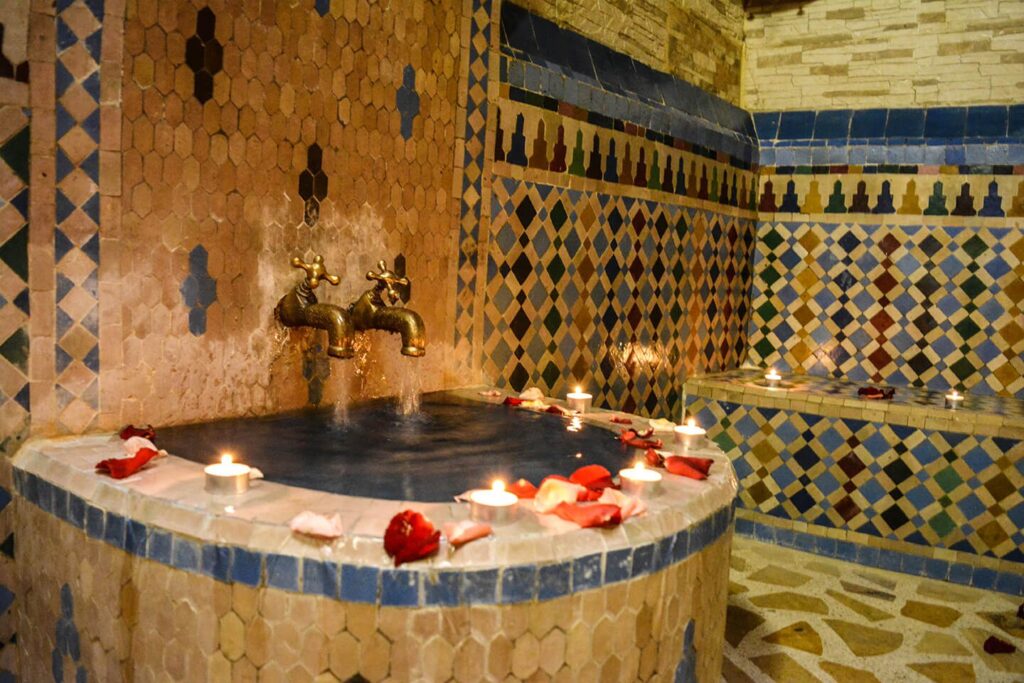
A tourist or riad hammam costs 250–600 dirhams and up. Private or semi-private, dimmed lighting, oils, a massage tacked on the end, towels provided, someone explaining what happens next. Comfortable, calm, and considerably less interesting.
Our honest recommendation for a first Moroccan hammam: if you’re travelling with someone who’s done it before, go public. If you’re alone and anxious, do the tourist version first and the public one later in the trip. Both are legitimate. The public one is the real thing.
What to bring
A public hammam supplies hot water and a room. Everything else is on you. Buy the lot at any local shop for well under 50 dirhams total.
- Savon beldi — the black soap. A soft, dark olive-oil paste that smells faintly of olives. This is the core of it.
- A kessa glove — coarse, dark, slightly abrasive. This is what does the scrubbing.
- Rghassoul — a mineral clay for hair and skin, optional but traditional.
- A towel, and a dry change of underwear.
- Flip-flops. Wet tiled floors. Non-negotiable.
- A plastic mat or stool if you have one. Most people sit on the floor.
- Shampoo, a comb, whatever else you’d normally use.
Tourist hammams provide all of this. You turn up with yourself.
What you wear
The question everyone actually wants answered.
Women: knickers, usually. Bare chested is normal in the women’s section of a public hammam and nobody looks. Bring a spare dry pair. Some women wear a swimsuit bottom instead; that’s fine too.
Men: underwear or swim shorts, always. Full nudity is not acceptable in the men’s section and would be genuinely shocking.
In a tourist hammam you’ll usually be given disposable underwear or told to keep your own on. Nobody is going to look at you strangely for keeping more on rather than less.
What actually happens, room by room
A traditional Moroccan hammam has three rooms, getting progressively hotter. You move through them.
The changing room. You leave your clothes here, usually in a locker or with an attendant. Take your bucket, soap and glove through with you.
The warm room. You fill a bucket from the taps, find a patch of floor, and sit. The point is to sit long enough that the steam and heat soften your skin — fifteen or twenty minutes. People pour water over themselves periodically. This is the part that feels like nothing is happening. Nothing is supposed to be happening.
The hot room. Hotter and steamier. Now you apply the black soap all over and leave it on for five to ten minutes. It doesn’t foam. It sits on you and works.
The scrub. This is the main event. You rinse the soap off, and then either you or an attendant goes at your skin with the kessa glove. If you’ve paid the attendant — and for a first time, pay the attendant — she or he will be brisk, thorough and entirely unsentimental about it.
What comes off is grey rolls of dead skin. A lot of it. This is normal, everybody produces it, and there is a genuine and slightly horrifying satisfaction in seeing it. First-timers are often shocked by the volume.
It is not painful, but it is not gentle either. If someone is scrubbing you and it’s too hard, say bshwiya — gently — and they’ll ease off.
Rinse, wash, clay. Rinse everything off, wash your hair, apply rghassoul if you brought it, rinse again. Then sit for a while longer.
The cool down. Back through the cooler rooms, dry off, dress, and sit for at least fifteen minutes before going outside. You’ll be dizzy if you don’t. Somebody will probably hand you a mint tea, and it will taste better than any tea you’ve had that week.
The whole thing takes an hour to ninety minutes.
Moroccan hammam etiquette
Short list, and none of it is difficult.
- No photographs. Ever. People are undressed. Leave the phone in the locker.
- Don’t stare. Obvious, and worth saying.
- Rinse your patch of floor before you leave it, so the next person has a clean spot.
- Share the taps. Fill your bucket and move so others can get in.
- Tip the attendant. Ten or twenty dirhams on top of the scrub fee.
- Sunday and Friday are busy. Friday particularly, before prayers. Go midweek for a quieter time.
- Cover up on the way home. You’ll be flushed, damp and pleasantly wrecked. Dress properly to walk back through the village.
Who shouldn’t go
The honest caveats, because the heat is real.
If you have heart problems, low blood pressure, or you’re pregnant, talk to a doctor first — the steam rooms are genuinely hot and you’re in them for a while. If you have sunburn, wait. A kessa scrub over sunburnt shoulders after a week of surfing is a specific kind of misery, and we’ve watched a guest discover this.
If you’re deeply uncomfortable with communal undress, the tourist version exists precisely for you and there’s no shame in it. And if you’ve had any recent skin treatment, waxing or a tattoo, leave it a couple of weeks.
Where to find a Moroccan hammam
Every town and most villages have one. They’re often unmarked from outside — a plain doorway, sometimes a small sign in Arabic, usually near the mosque, because hammams and mosques traditionally shared a water supply and a furnace.
Ask where you’re staying. Any guesthouse, camp or riad will point you to the local one and tell you the men’s and women’s hours, which alternate through the day and vary by place. In Imsouane, this is a question we get asked most weeks and the answer is a two-minute walk from the camp.
In Marrakech and Fes there are famous historic hammams that have become half tourist attraction, and modern spa hammams in most riads. Both are fine. If you want the version with families and buckets, ask a local rather than a hotel concierge — see our wider notes on combining Marrakech with the coast.
Why a Moroccan hammam after surfing is particularly good
This is the specific case we can speak to.
Four days of surfing leaves you with sore shoulders, salt in your hair, and skin that’s been in cold Atlantic water for hours at a time. Twenty minutes of steam and a hard scrub does more for that than anything else available. It’s also the ideal use of a flat day, when there’s no swell and everyone’s at a loose end.
Guests who come for the surf and yoga side of things tend to take to it fastest, since the logic is the same — the hammam is the recovery half of a physical week. It sits naturally alongside the other things worth doing here, which we’ve listed in our guide to the village and around it, and it’s one of the options under extra activities if you’d rather we arranged it.
If it’s your first trip to the country generally, the hammam is one item on a longer list of things worth knowing — the rest are in our guide to a first time in Morocco. For broader background on the tradition, Wikipedia covers the history of hammams, and BBC Travel has covered Moroccan bath culture more than once.
Ask us when you book a week and we’ll tell you which day suits, which is usually whichever one the ocean has gone flat.
Frequently asked questions
What do you wear in a Moroccan hammam?
Women generally wear knickers or swimsuit bottoms and go bare-chested in the women’s section, which is completely normal there. Men wear underwear or swim shorts and full nudity is not acceptable. Tourist hammams usually provide disposable underwear. Nobody will think twice if you keep more on rather than less.
What should I bring to a public hammam?
Black soap (savon beldi), a kessa scrubbing glove, flip-flops for the wet floors, a towel and dry underwear. Rghassoul clay, shampoo and a comb are optional extras. The whole kit costs well under 50 dirhams at any local shop. Tourist hammams provide everything.
Does the hammam scrub hurt?
It’s vigorous rather than painful. The kessa glove is coarse and the attendant will be brisk and thorough, and a surprising amount of grey dead skin comes off — that’s normal and everybody produces it. If it’s too hard, say “bshwiya”, meaning gently, and they’ll ease off.
How much does a Moroccan hammam cost?
A public neighbourhood hammam costs 10–20 dirhams to enter, plus 50–100 for an attendant to scrub you, plus a small tip. A tourist or riad hammam with oils, private rooms and a massage starts around 250 dirhams and goes up considerably from there.
Are hammams mixed or separate for men and women?
Separate, always — either different entrances or different hours through the day, which vary by place. Ask where you’re staying for the local timetable. Tourist and riad hammams are often private or bookable for couples.
How long does a hammam take?
Between an hour and ninety minutes. You spend fifteen to twenty minutes in the warm room letting the steam soften your skin, five to ten with black soap on, then the scrub, then rinsing and washing. Add at least fifteen minutes cooling down afterwards before you go outside.
Should I go to a public hammam or a tourist one?
Public if you want the real thing and have a bit of nerve — it’s cheap, communal and how Moroccans actually live. Tourist if you’re alone, anxious or want someone to explain each step. Doing the tourist version first and the public one later in the trip is a perfectly good plan.
Who should avoid a Moroccan hammam?
Anyone with heart problems or low blood pressure should check with a doctor first, and pregnant women should too — the steam rooms are genuinely hot. Skip it if you’re sunburnt, as a scrub over burnt skin is miserable, or if you’ve recently had waxing, a tattoo or any skin treatment.

0 Comments